
The North Anthony Area Association was formed:
“To provide for the maintenance and improvement of that area of Fort Wayne, Indiana, which is adjacent to or surrounded by North Anthony Boulevard, as well as such additional areas as may be affected by the use, maintenance, and improvement of North Anthony Boulevard; to maintain, beautify and improve North Anthony Boulevard in the City of Fort Wayne, Indiana, as a residential neighborhood and to prevent the use of North Anthony Boulevard for purposes detrimental to the residential nature of the surrounding or adjacent properties.” — North Anthony Area Association Articles of Incorporation
Before the Association
Long before the North Anthony Area Association was formed in 1974, the surrounding neighborhood was already being marketed, subdivided, and built as a distinct residential area. The newly added newspaper scans help show how the area around North Anthony, Lakeside, and Kensington Park developed over the first half of the twentieth century.
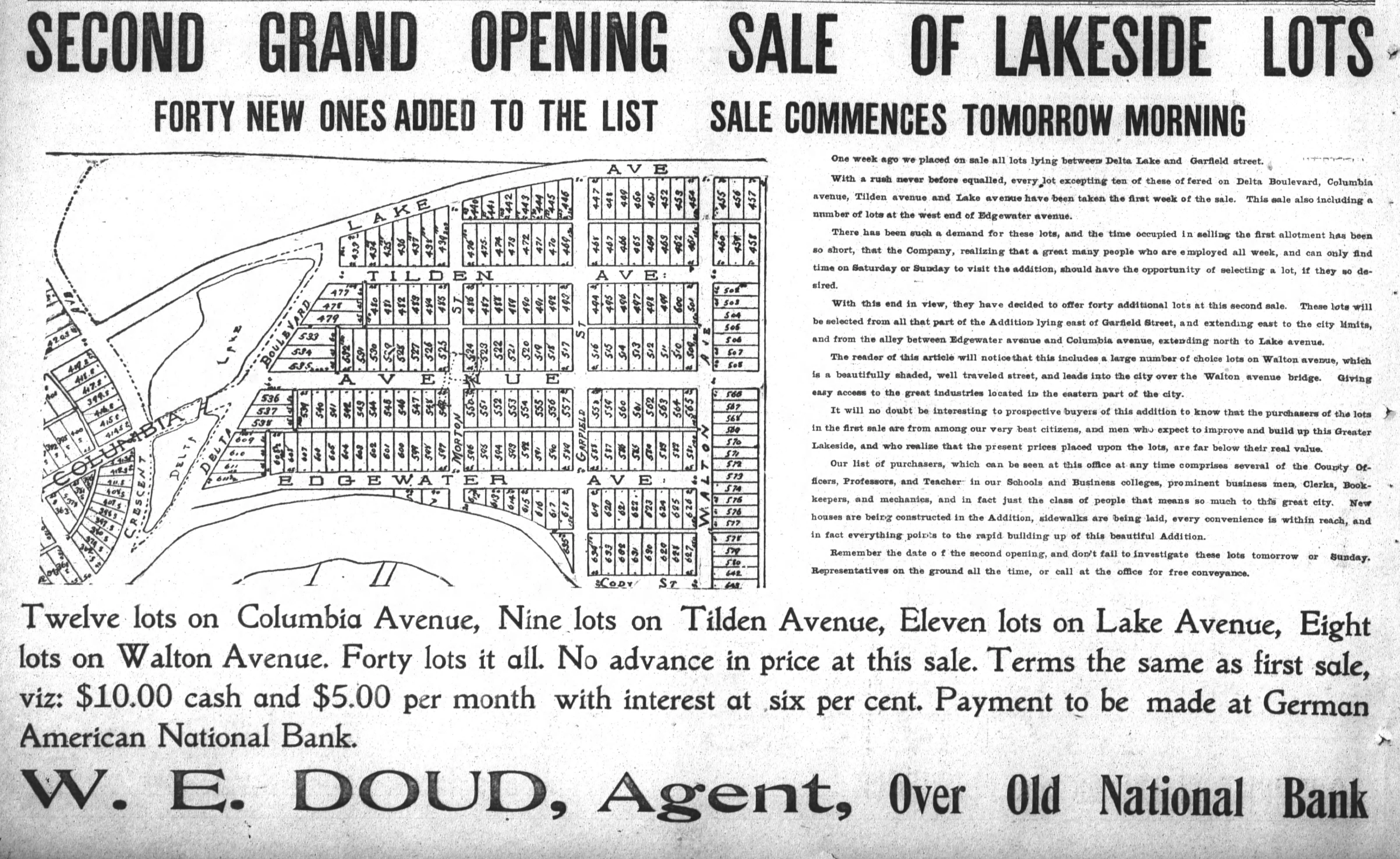
An October 6, 1905 Fort Wayne Sentinel advertisement for the “Second Grand Opening Sale of Lakeside Lots” shows the area being actively subdivided and sold decades before the association existed. The ad includes a plat near Lake, Tilden, Edgewater, and Walton and describes the offering as part of the growing Lakeside addition, with W. E. Doud acting as agent.
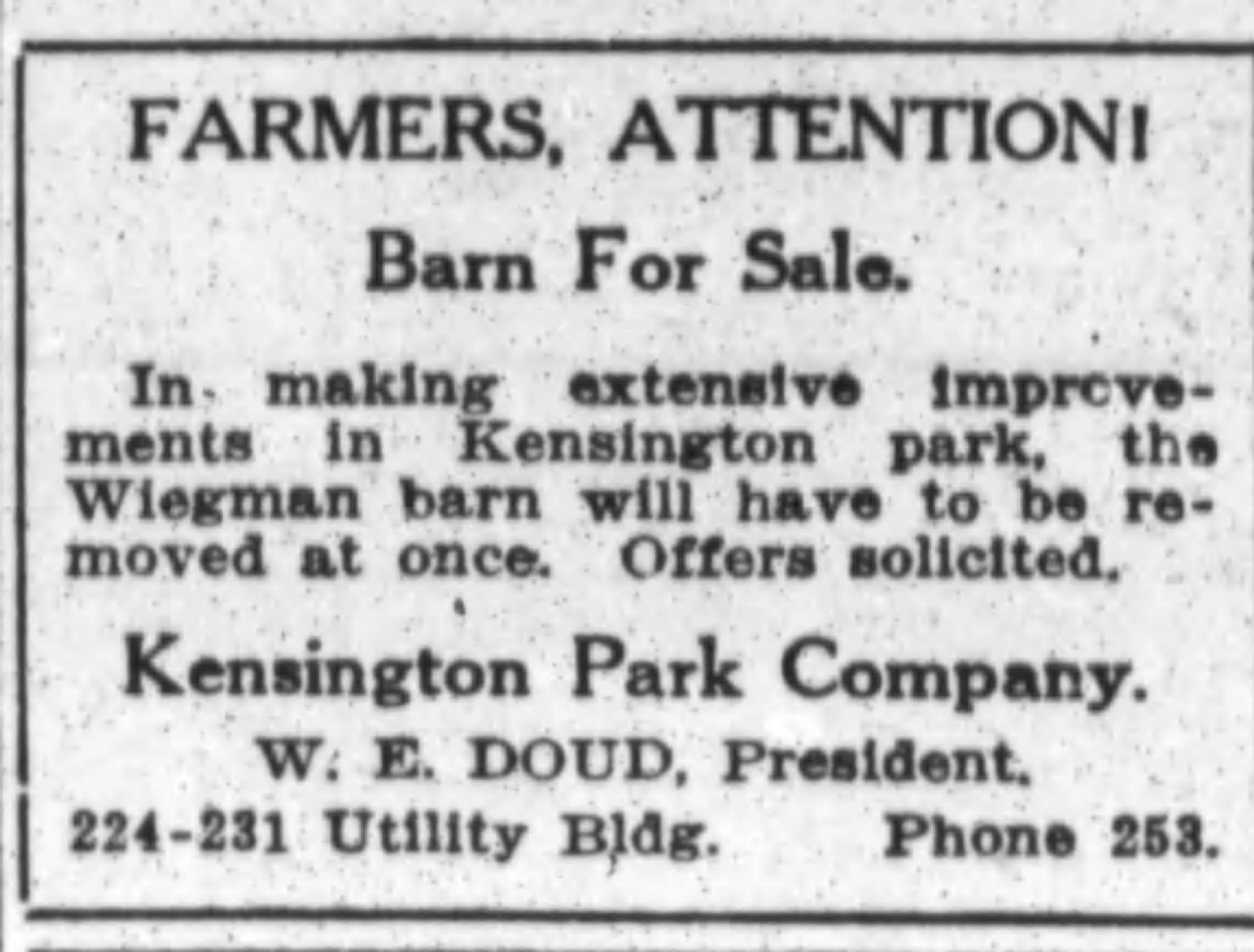
By 1912, a Fort Wayne Sentinel feature on how different parts of the city got their names was already treating Lakeside as a recognizable district on the east side. A few years later, the development focus had shifted toward Kensington Park and the blocks around North Anthony. A June 29, 1917 Journal Gazette notice states that “extensive improvements” in Kensington Park were underway, enough that the Wiegman barn had to be removed.
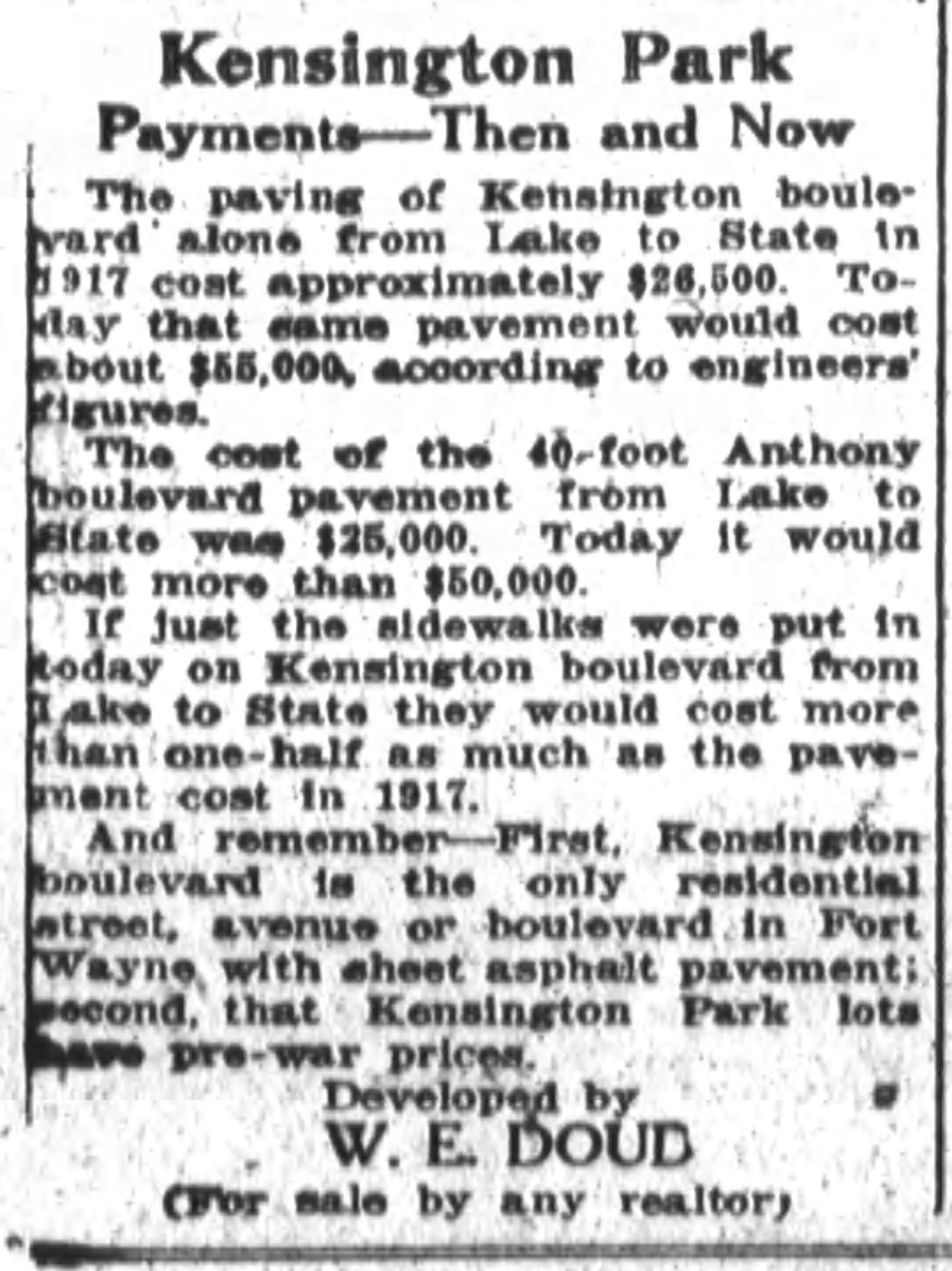
A May 13, 1922 advertisement looking back on Kensington Park improvements claimed that paving on Kensington Boulevard from Lake to State and the 40-foot Anthony Boulevard pavement from Lake to State had both been completed in 1917. The same ad promoted Kensington Park as a residential subdivision with “pre-war prices,” as the US had entered World War I on April 6 of that year.
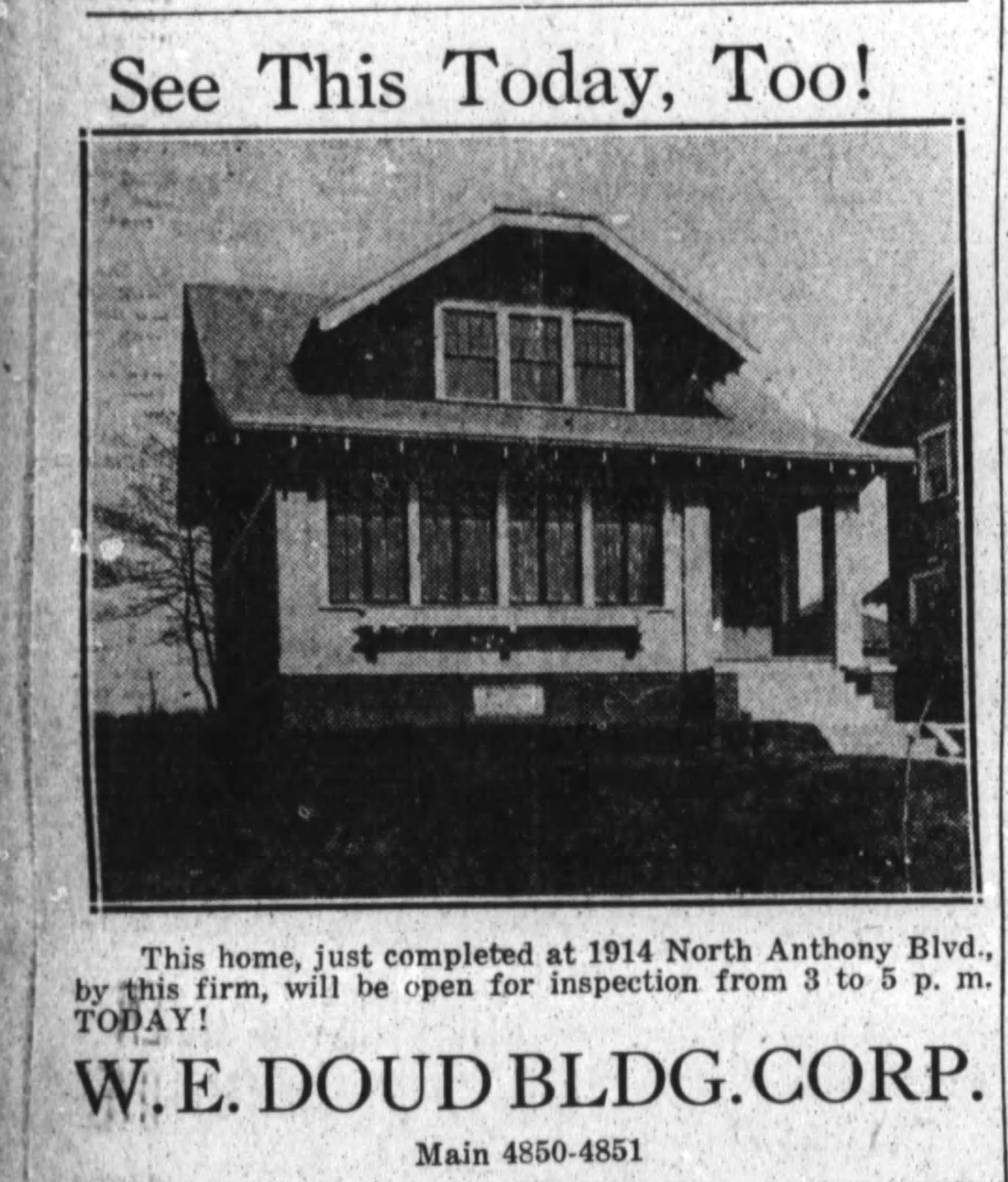
The surviving 1923 real-estate ads push that story further. One advertisement invites readers to inspect a newly completed house at 1914 North Anthony Boulevard, built by the W. E. Doud Building Corporation. By then, North Anthony was not only a planned corridor on paper but an address being marketed to homebuyers as part of an established residential district.
Widening Anthony
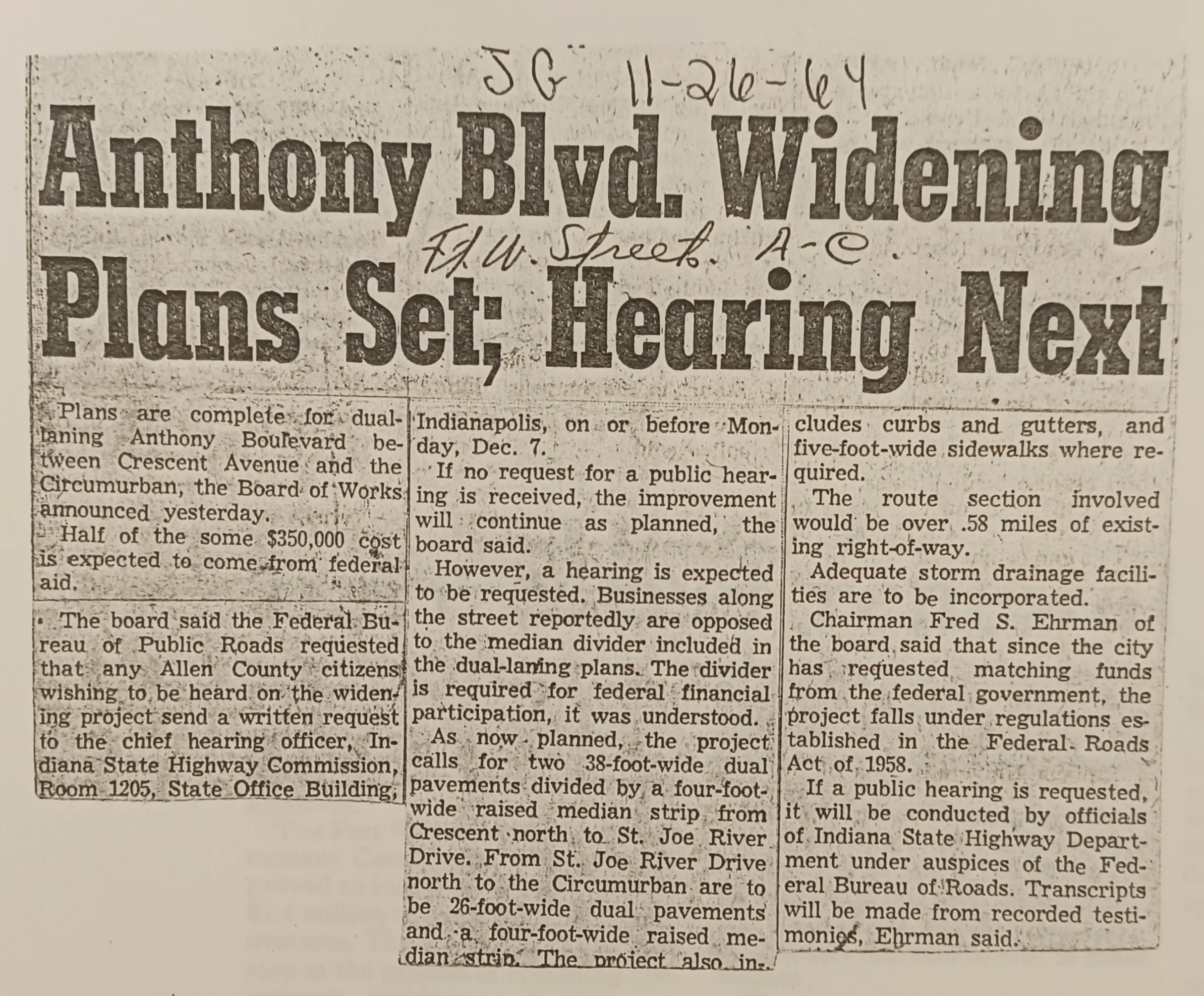
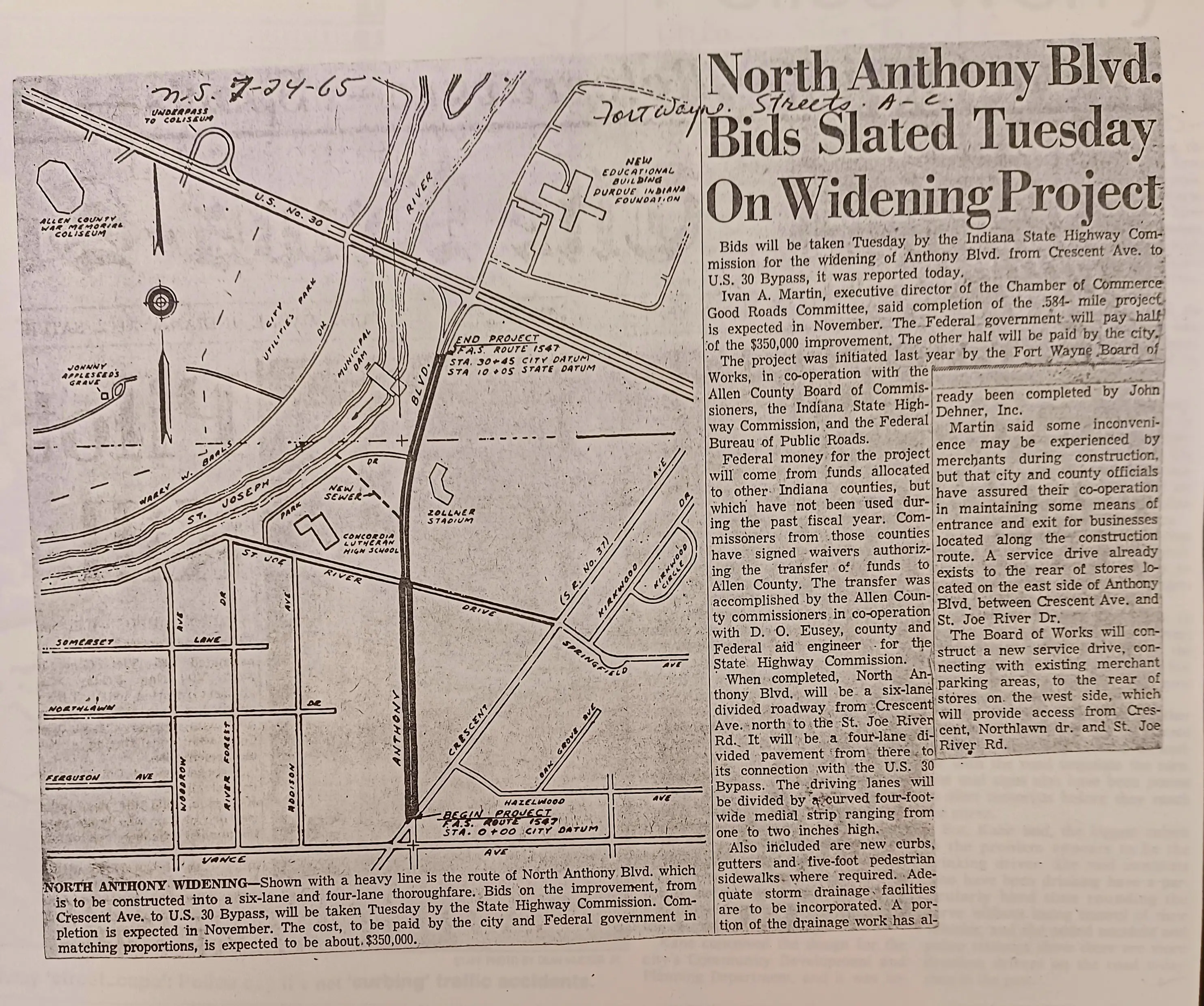
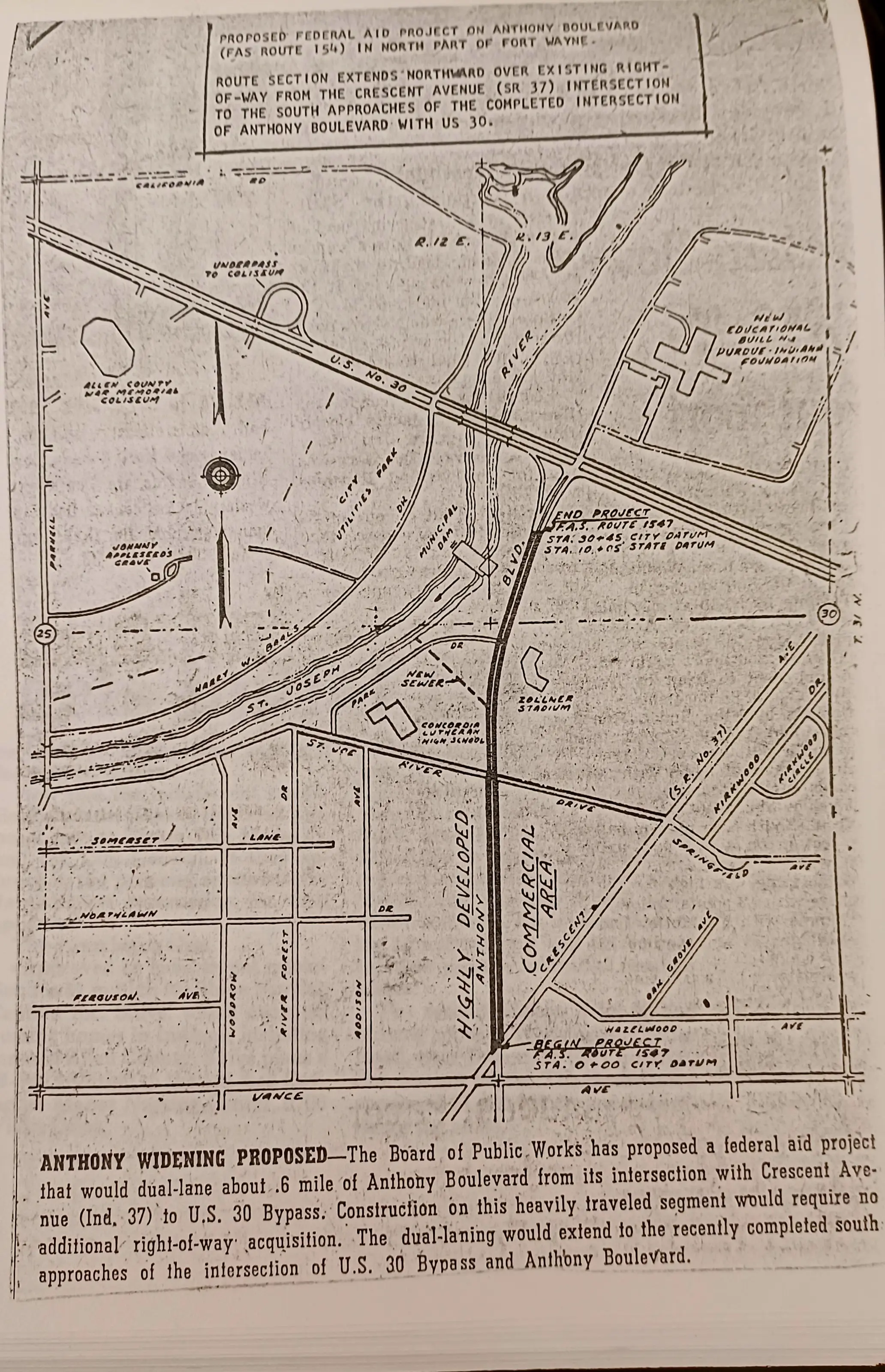
In the mid-1960s, roposals began circulating for a redesign of North Anthony that would widen it to four lanes, using a mix of federal and local funds. Work began in 1965 that widened North Anthony north from Crescent Avenue to Coliseum Boulevard to its present width in the commercial corridor.
Formation of the Association
By the early 1970s, North Anthony residents were organizing against plans to widen the boulevard and increase through-traffic in the residential portions. Flyers from the period argue that widening was unnecessary, would damage the character of the neighborhood, and would intensify traffic noise and speed on what residents viewed as a residential boulevard rather than a commuter route.
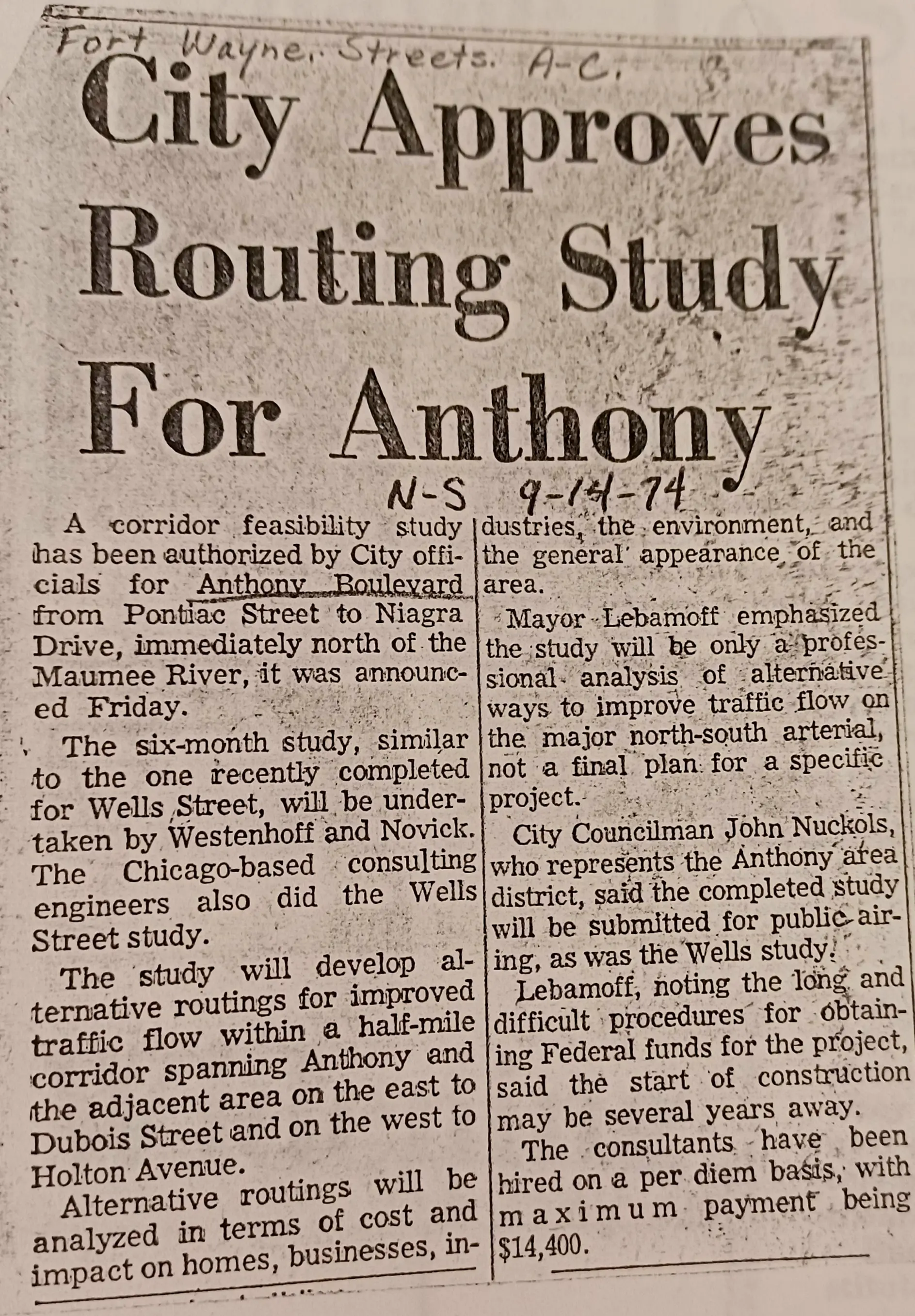
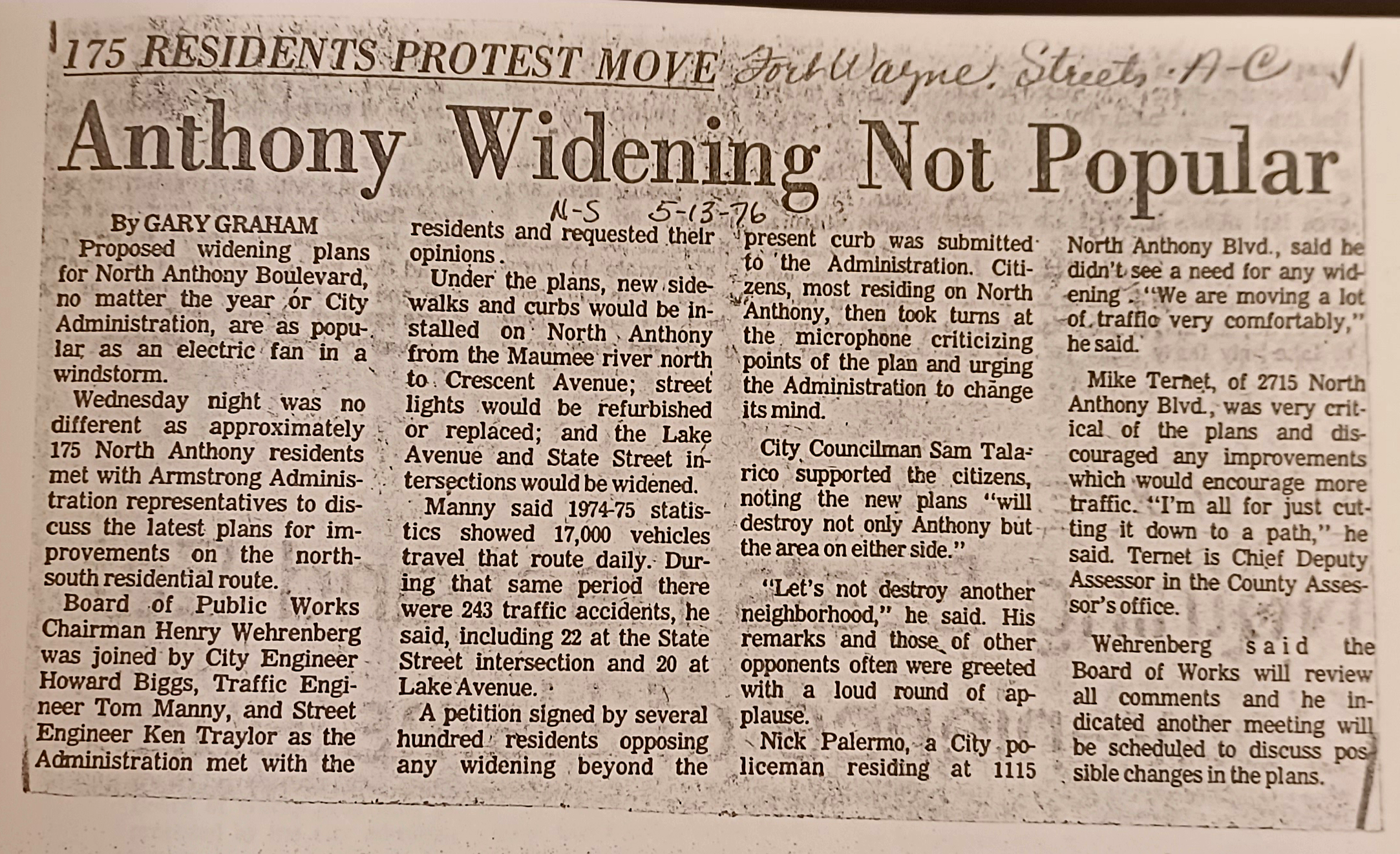
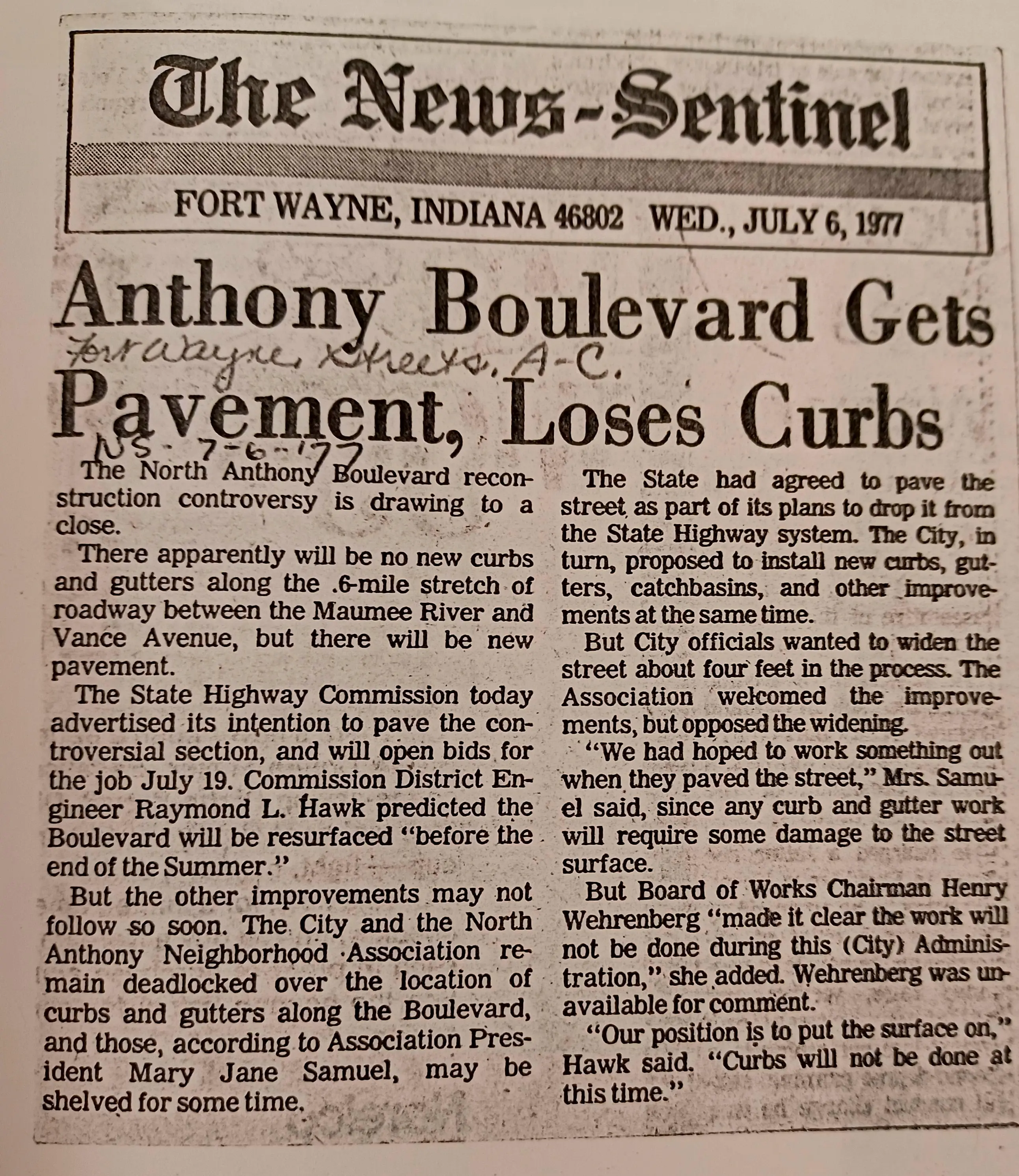
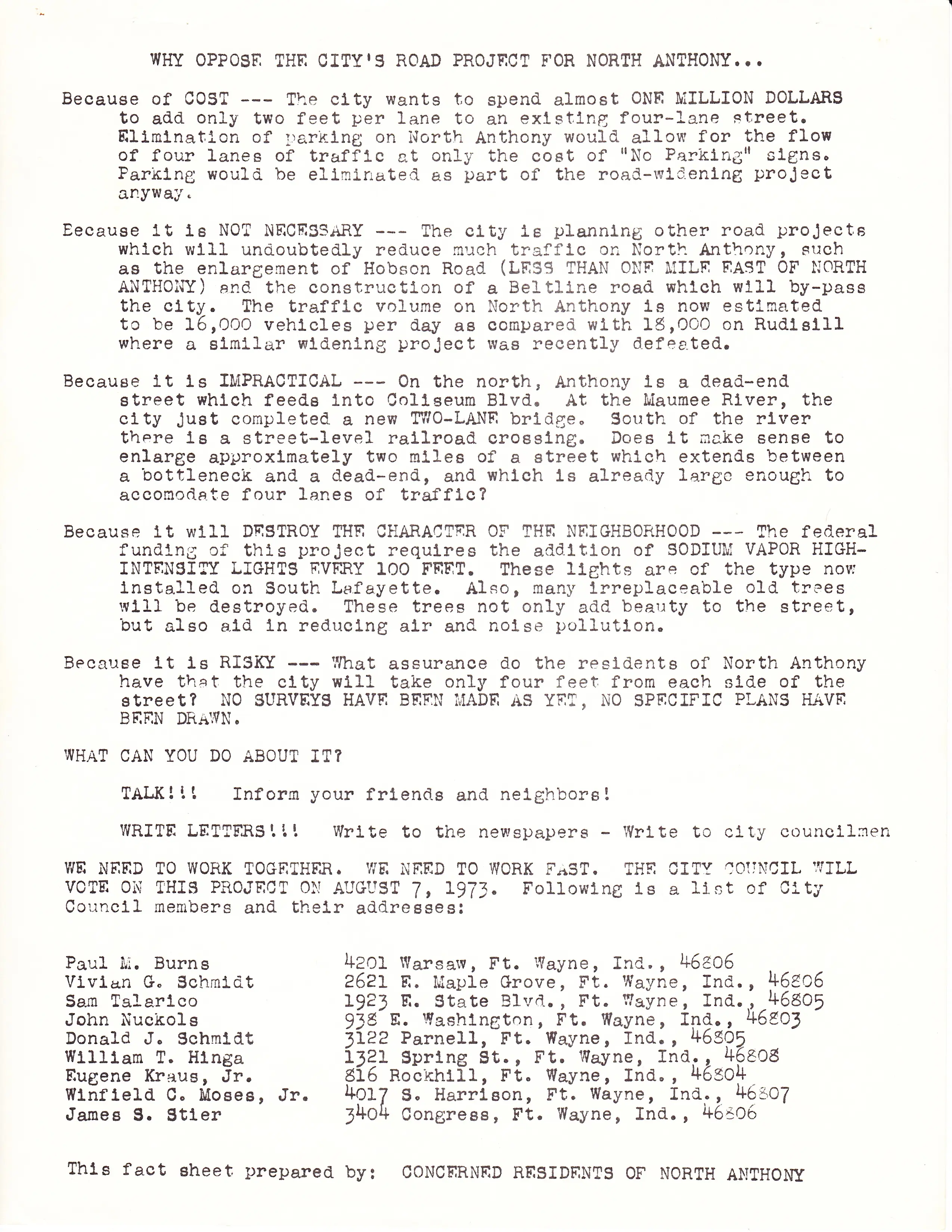
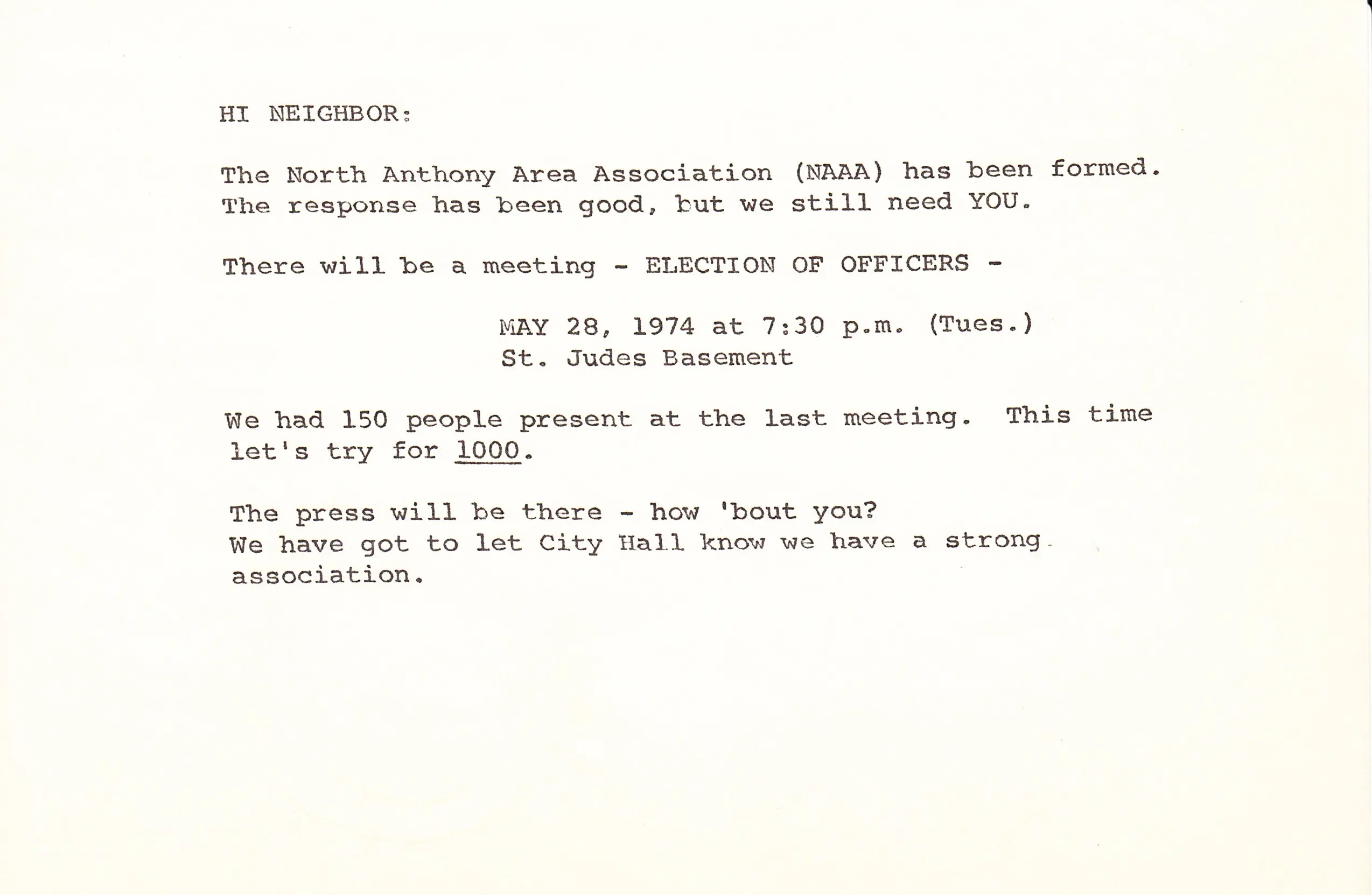
By 1974, those concerns had become a formal neighborhood organization. A May 28, 1974 notice announces that the North Anthony Area Association had been formed and was holding an election of officers in the basement of Saint Jude Catholic Church on Randallia. It also notes that 150 people had attended the prior meeting, a sign that traffic, curbs, and boulevard planning had become major neighborhood issues.
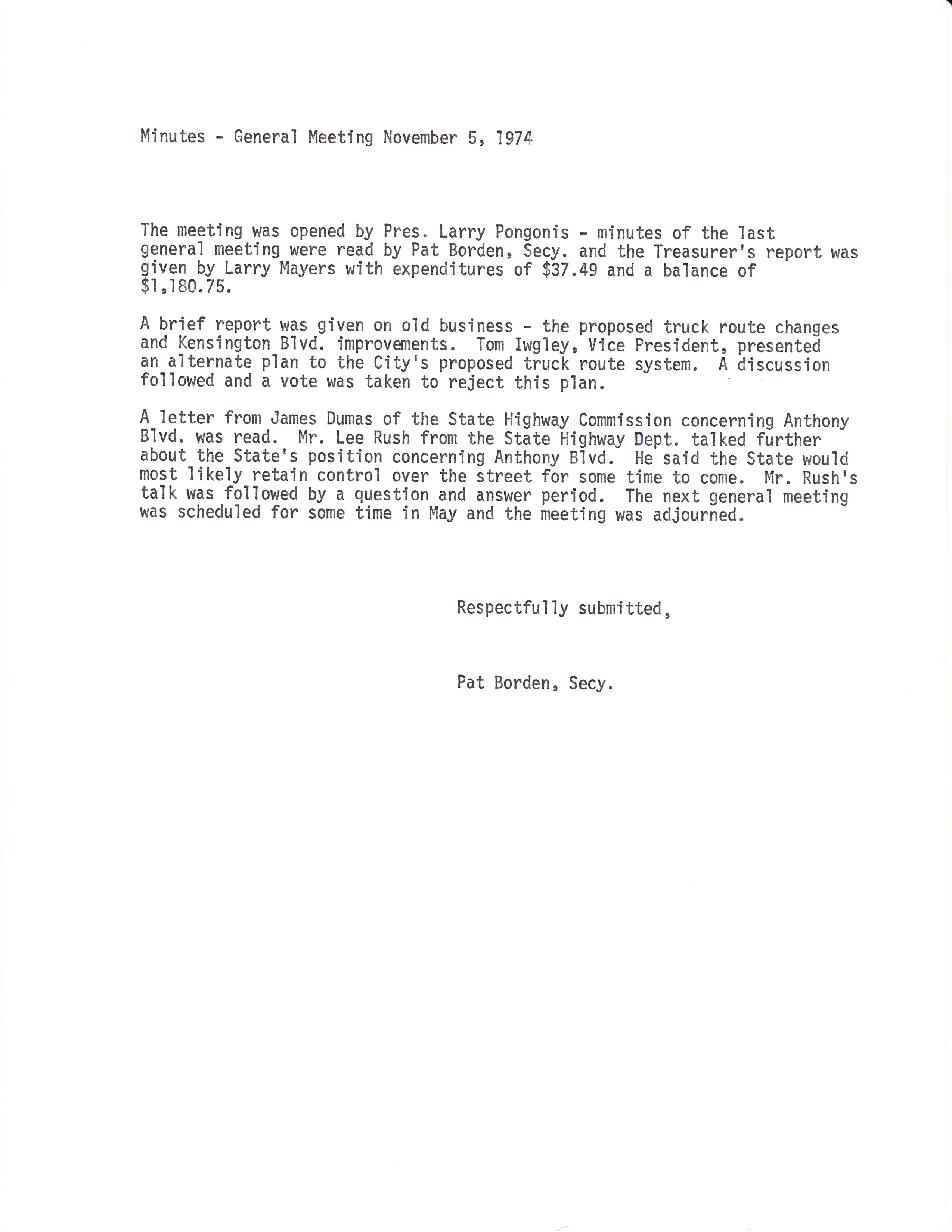
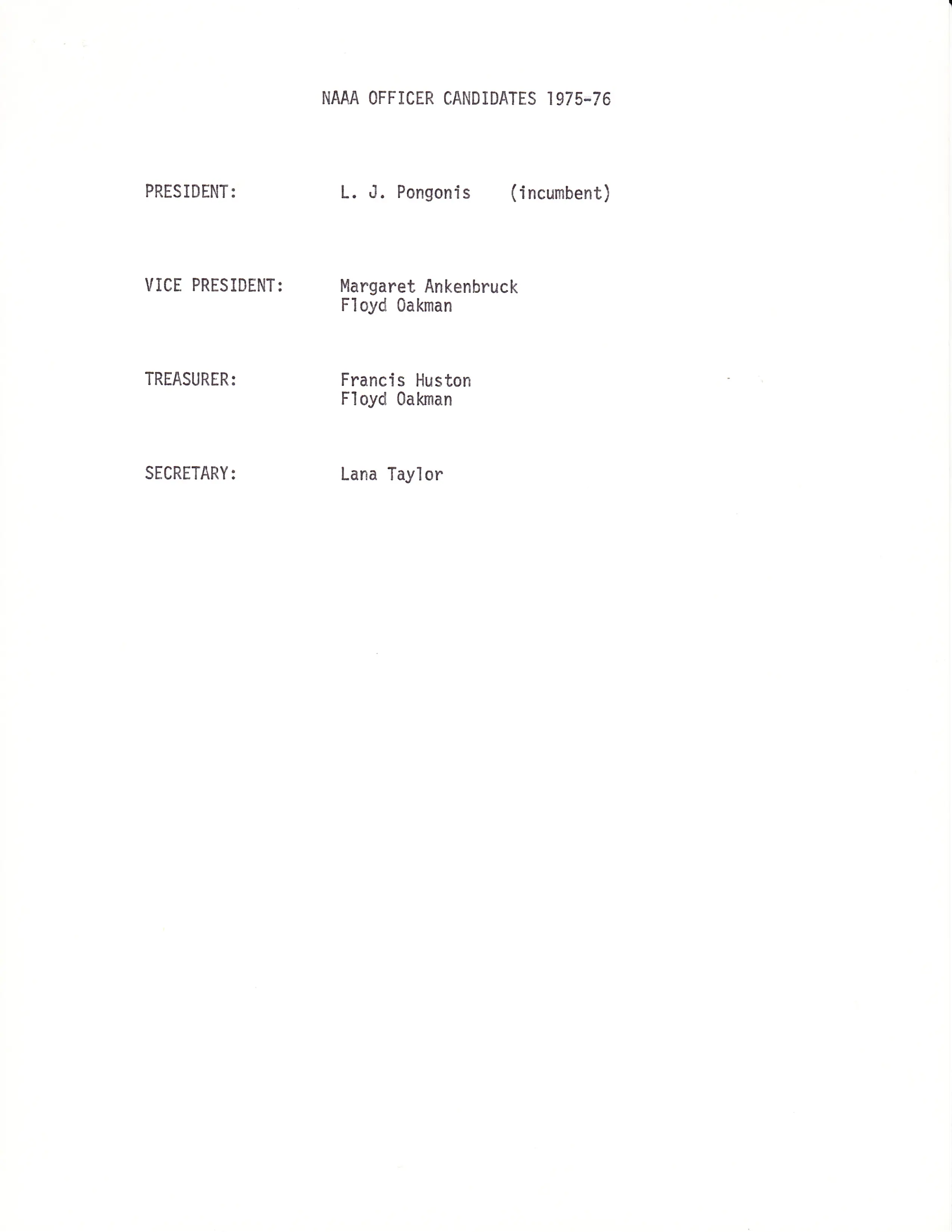
The surviving November 1974 minutes show an association that was already functioning as a regular civic organization, with President Larry J. Pongonis, Secretary Pat Borden, and Treasurer Larry Mayers. Those minutes mention discussion of truck-route changes, Kensington Boulevard improvements, and a state highway communication regarding Anthony Boulevard. They also note that residents heard from Lee Rush of the State Highway Department about the state’s position on Anthony Boulevard and the future of state control over the street.
In 1976, the association continued to organize public meetings about North Anthony’s future. A March 1976 news release advertised a meeting where residents could hear from the State Highway Commission, County Council, and the Fort Wayne Board of Public Works about road and bridge improvements and long-range plans for the North-South arterial. A September 22, 1976 meeting notice shows the association still mobilizing residents around the administration’s latest proposal while also functioning as a membership organization, with a tear-off form listing dues of $5.00 for new members and $2.00 for renewals. During the same period, the association was also advocating for practical neighborhood improvements such as curbs, traffic management, and public communication.
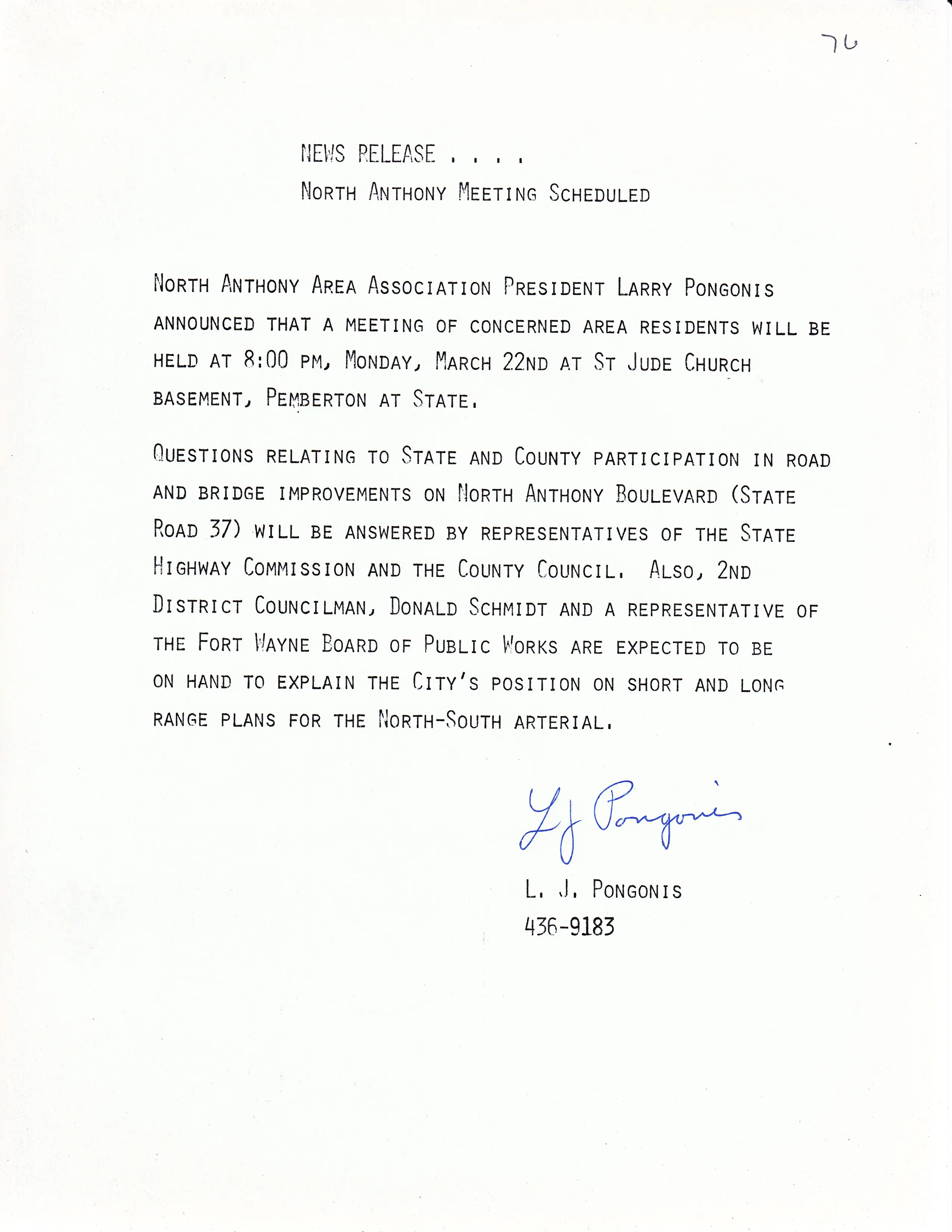
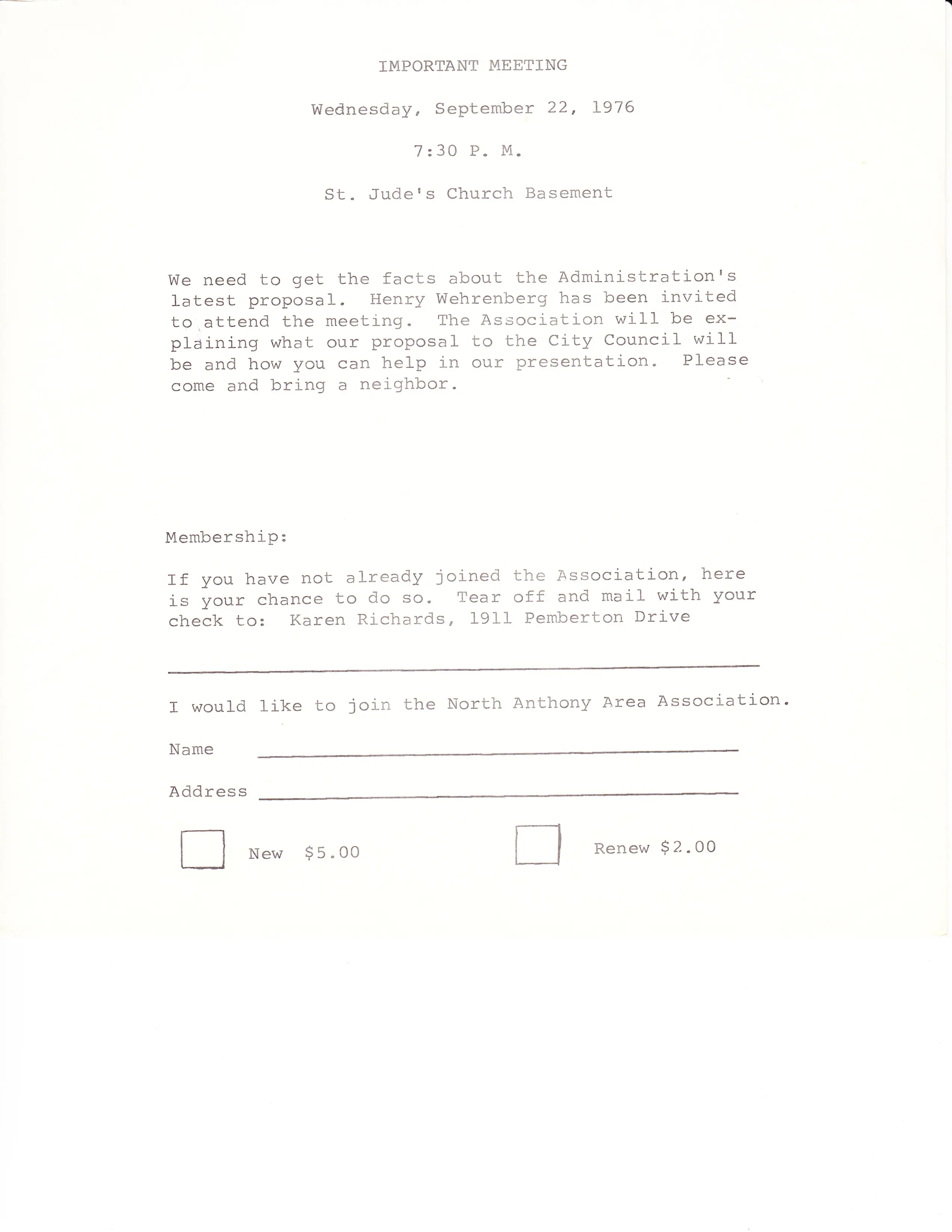
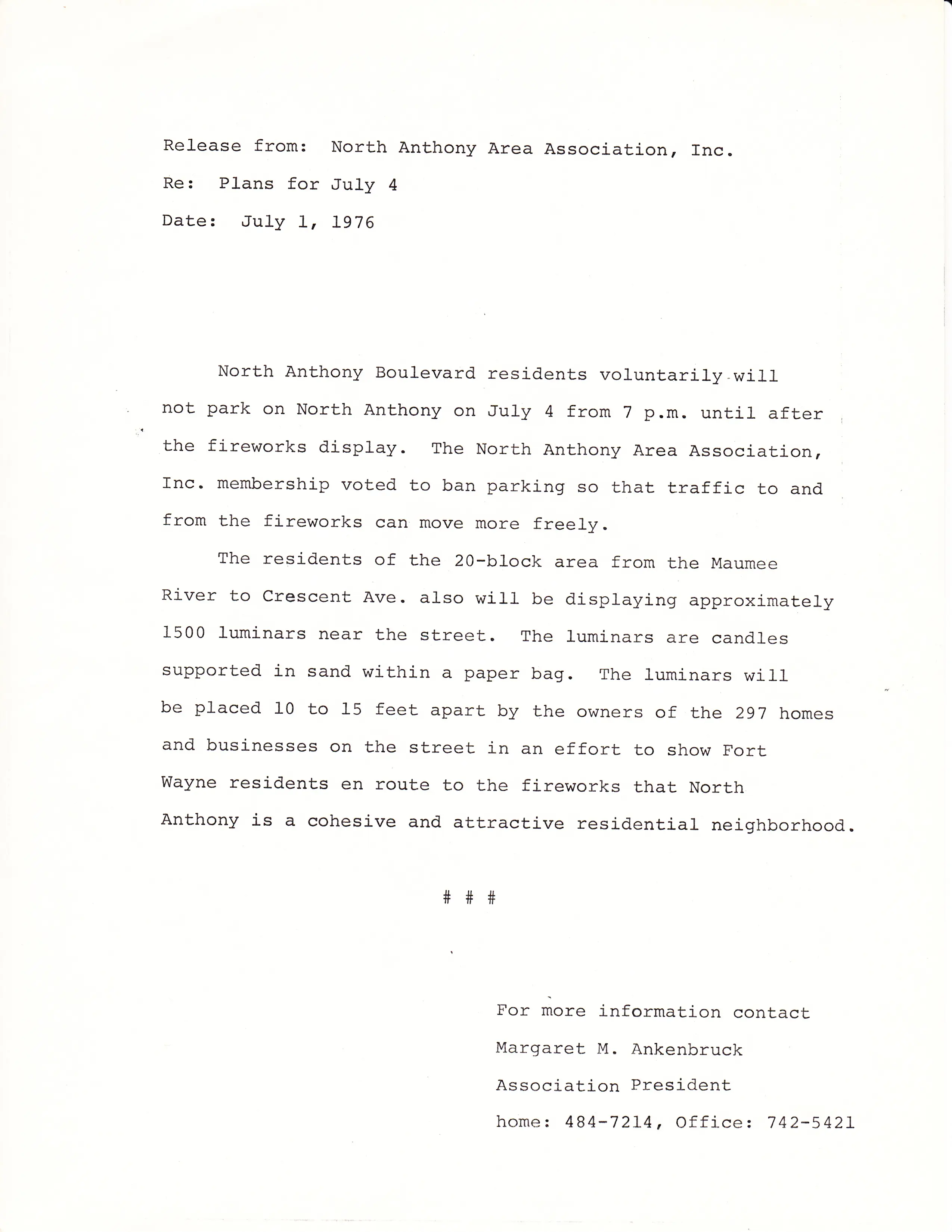
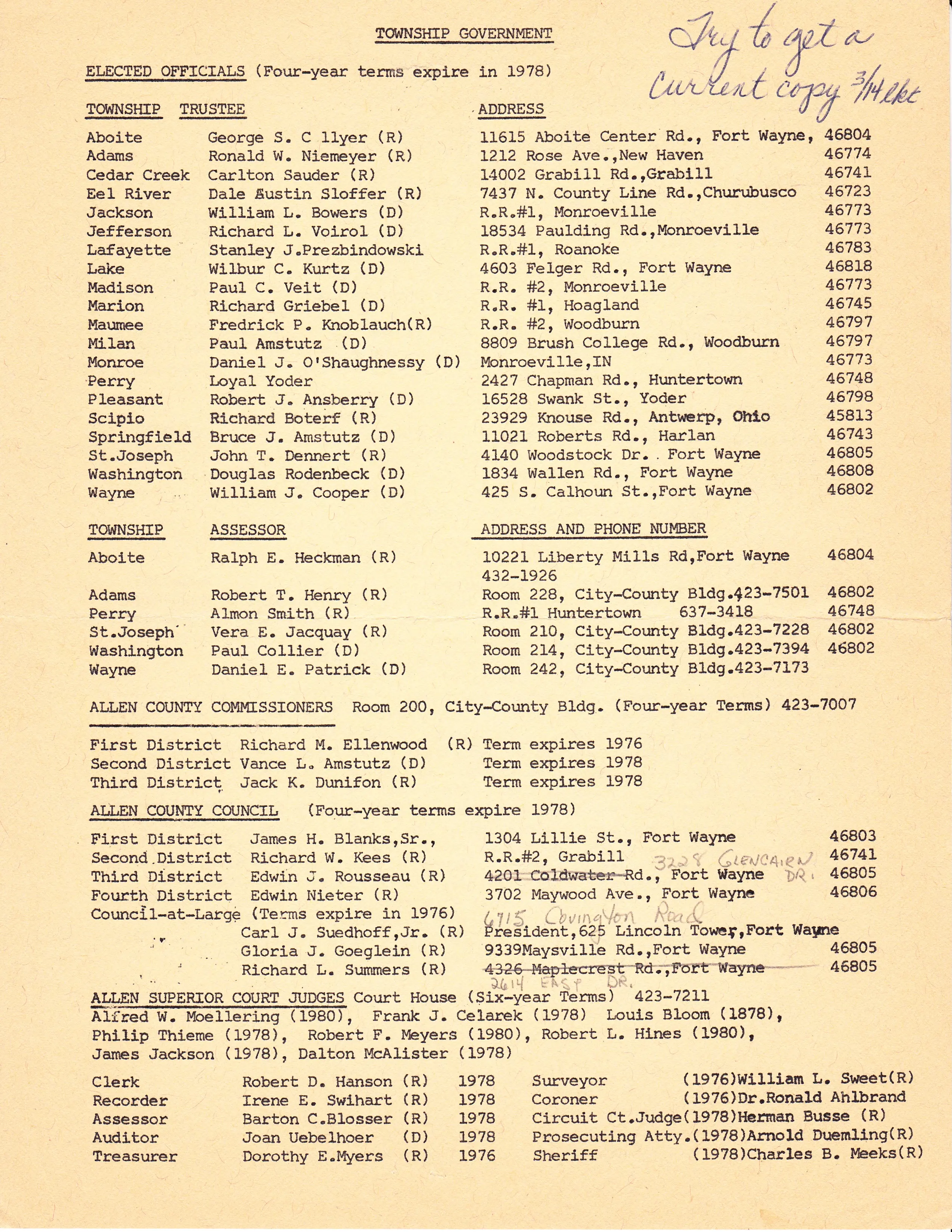
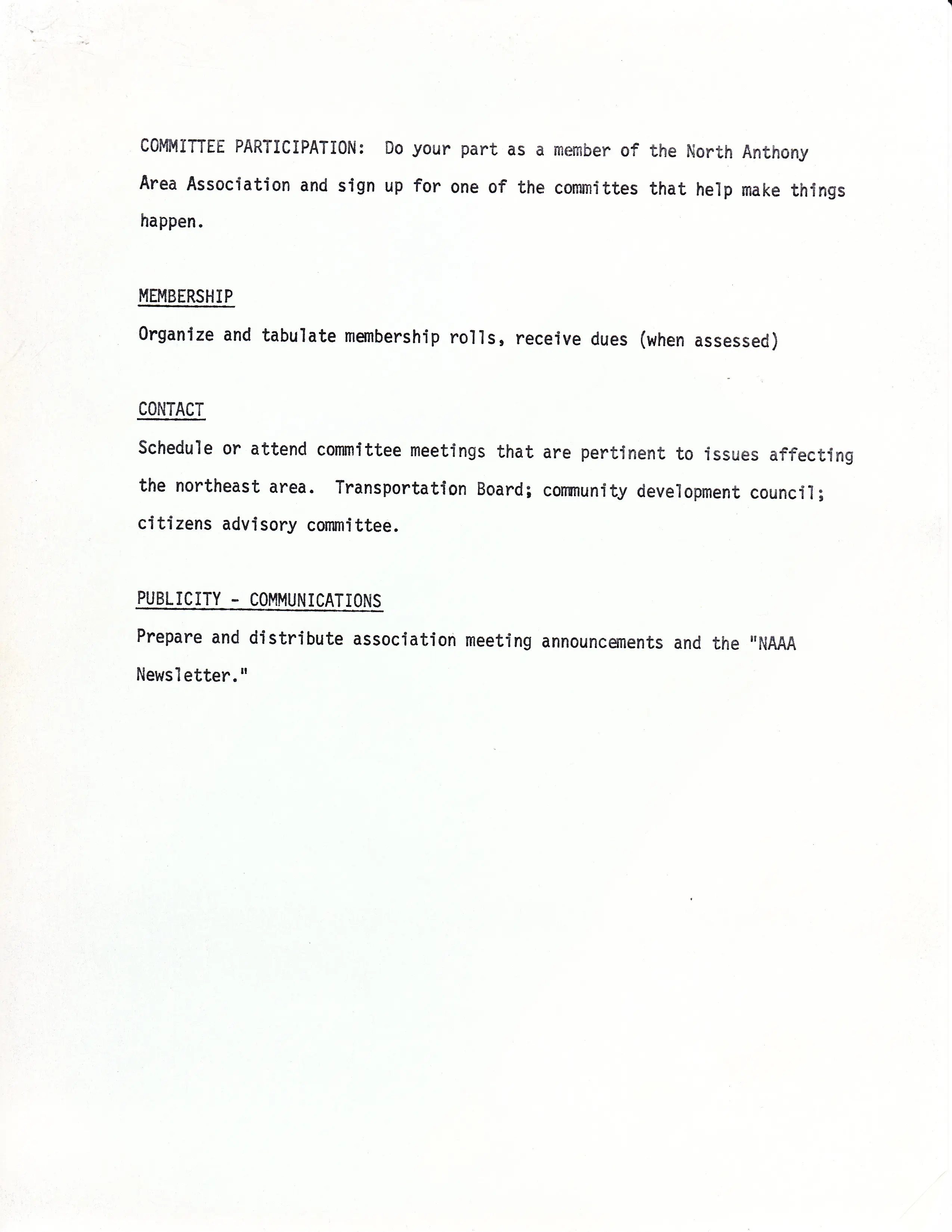
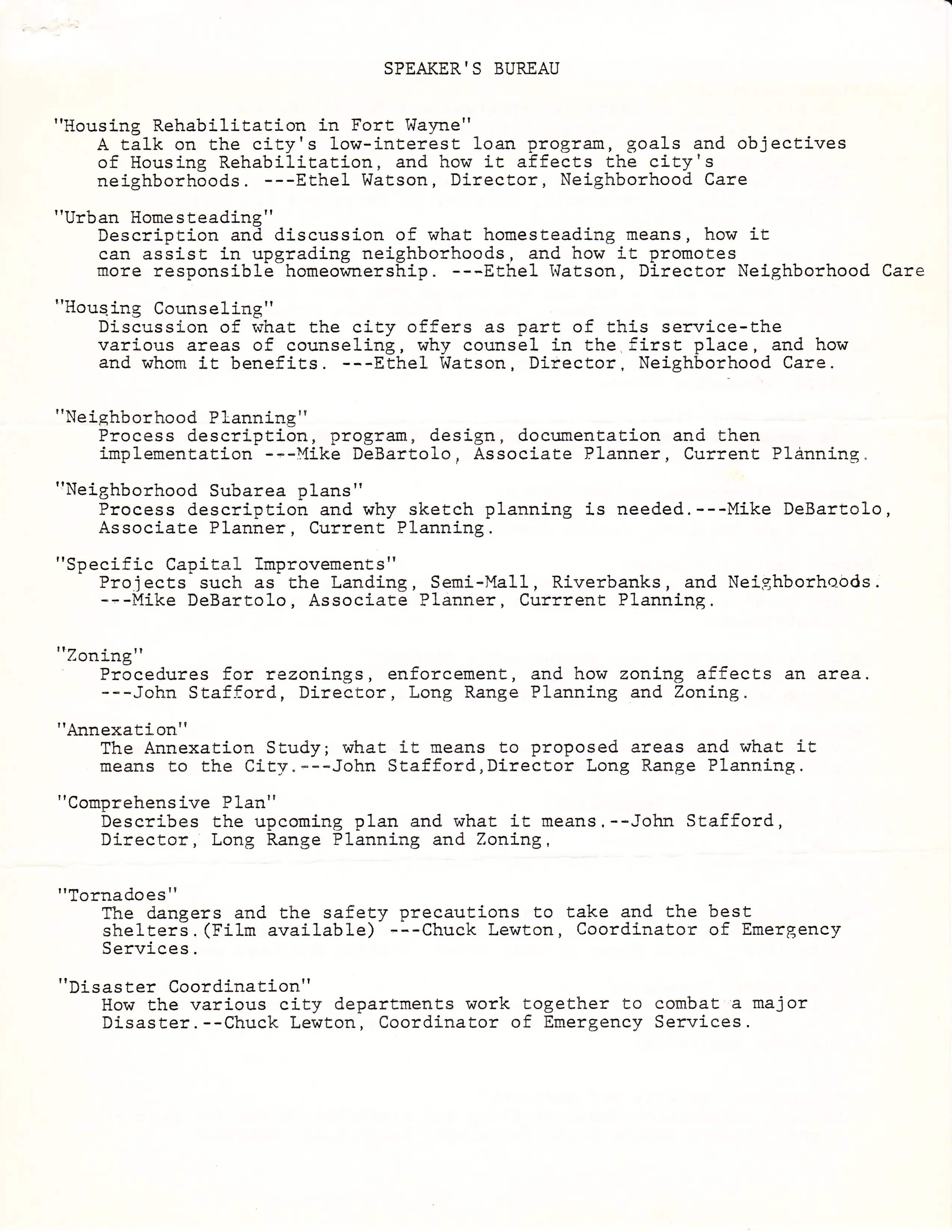
These materials show that the association was not focused solely on opposition. It was also building internal structure. Committee signup sheets from the period mention membership, public contact, and publicity/communications work, including distribution of the NAAA newsletter. The “Speaker’s Bureau” documents show the group thinking seriously about neighborhood education, with suggested talks on housing rehabilitation, neighborhood planning, annexation, zoning, traffic engineering, highway safety, family safety planning, sanitation, and parks and recreation.
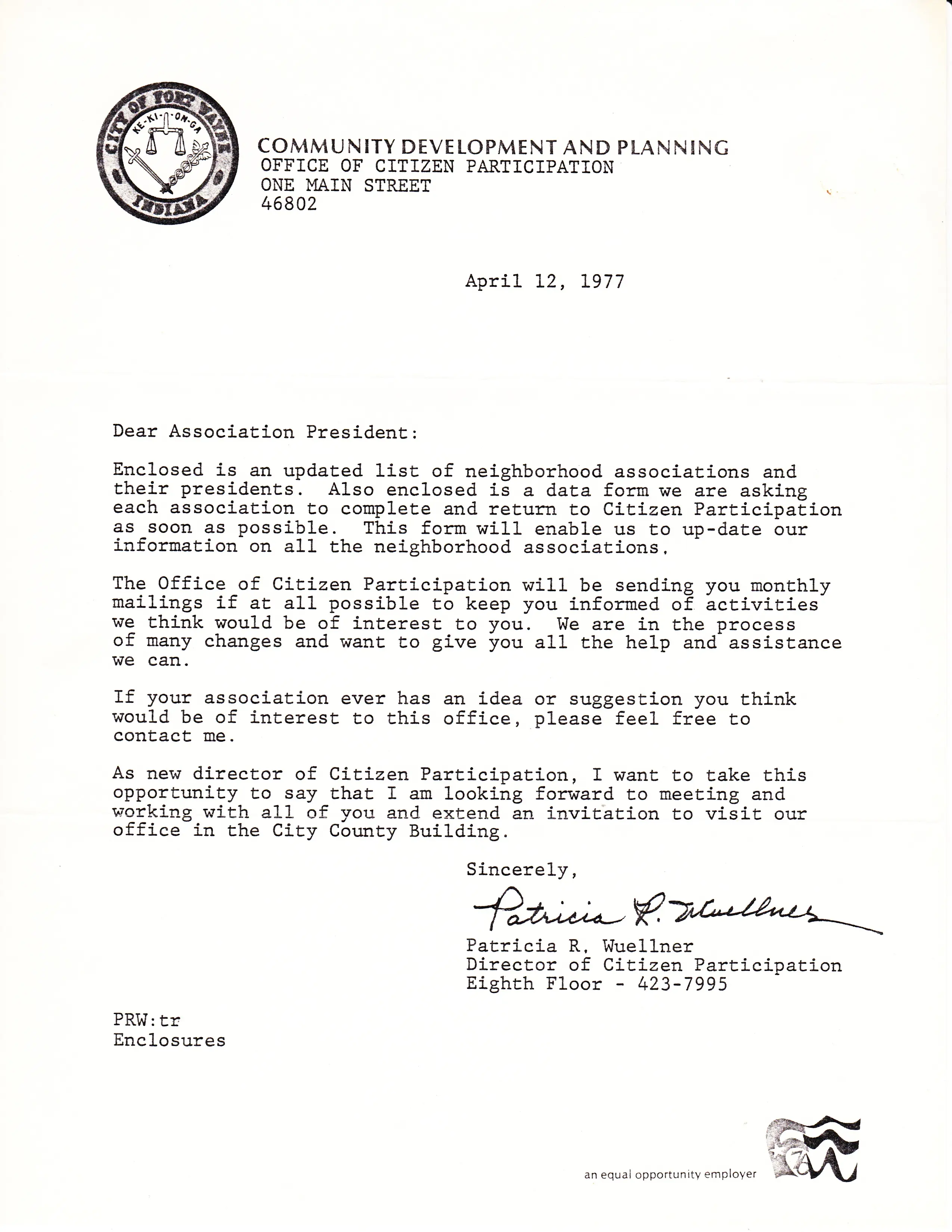
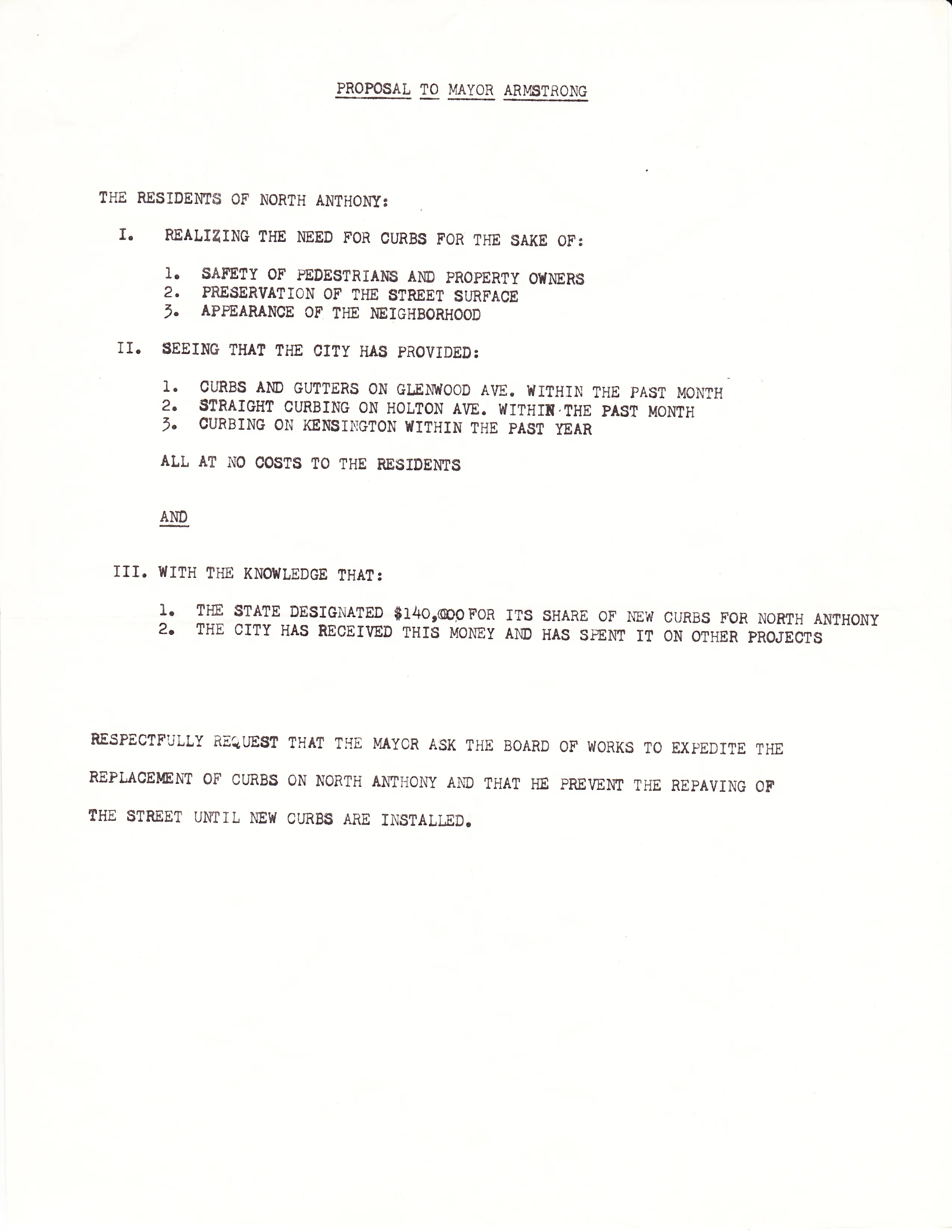
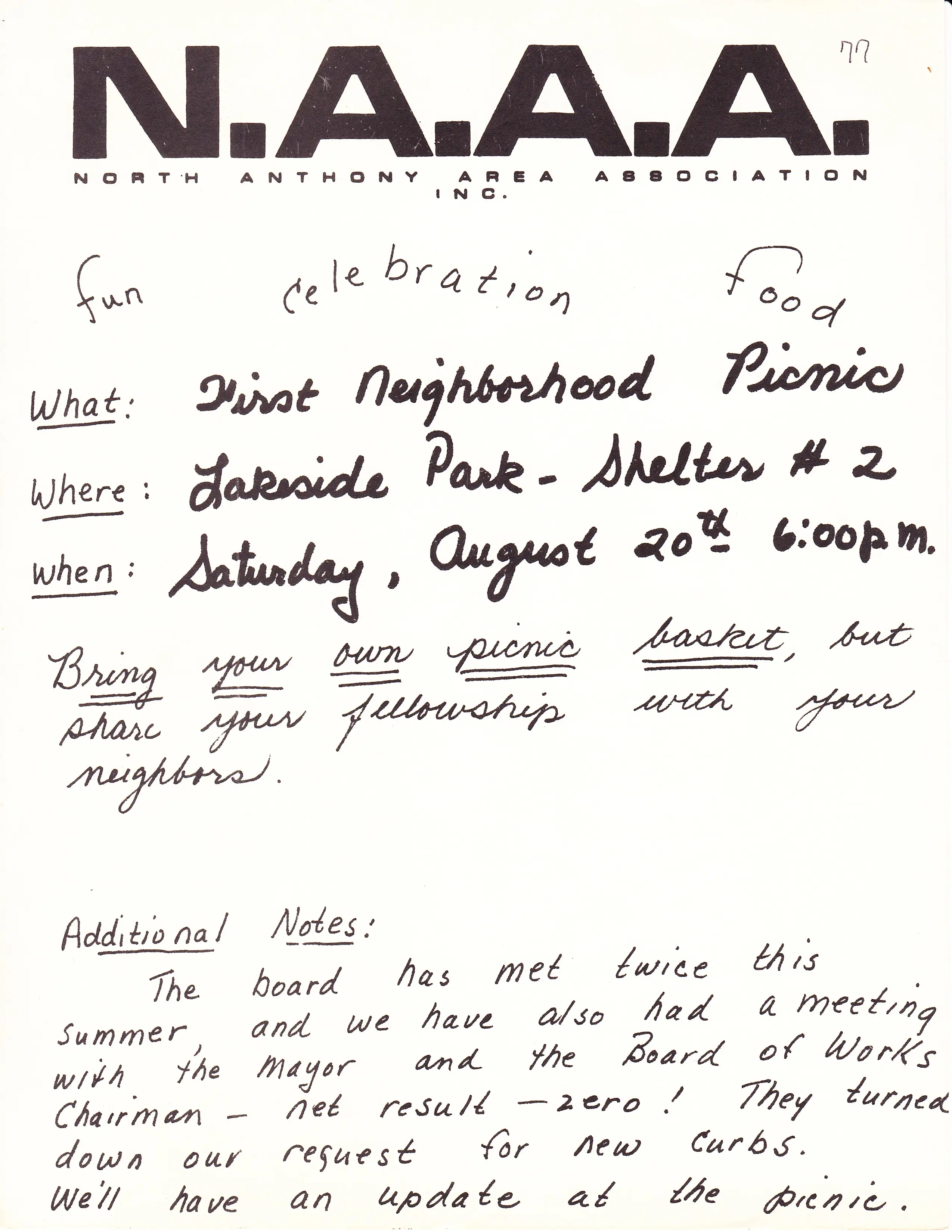
By 1977, the association was active enough to appear in city neighborhood-association updates and to hold community events such as its first neighborhood picnic at Lakeside Park on August 20, 1977. The surviving flyers from 1977 also show a more recognizable public-facing identity, including the large “N.A.A.A.” masthead used on meeting and event notices. A handwritten note on the picnic flyer says the board had already met twice that summer and had also met with the mayor and the Board of Works chairman, though their request for new curbs had been turned down.
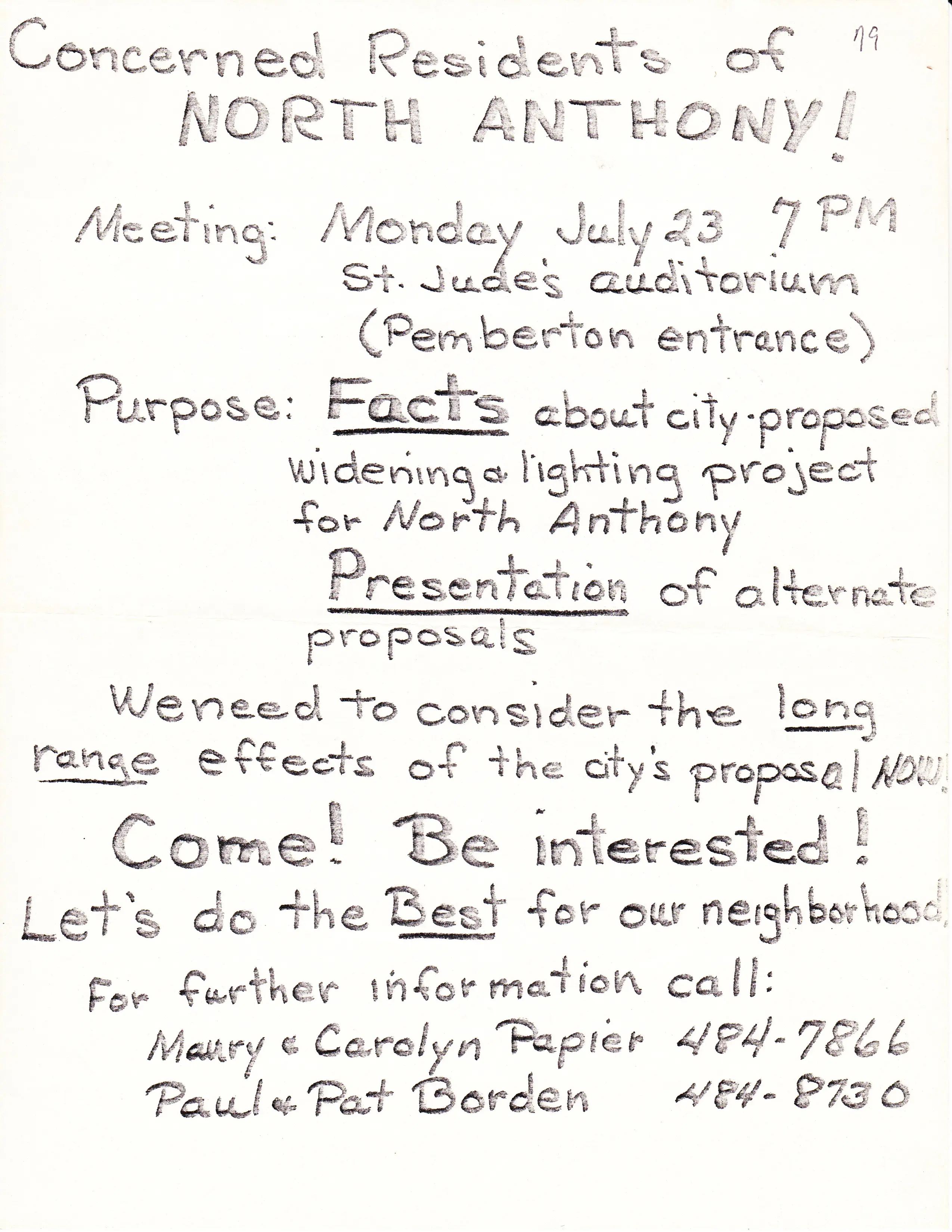
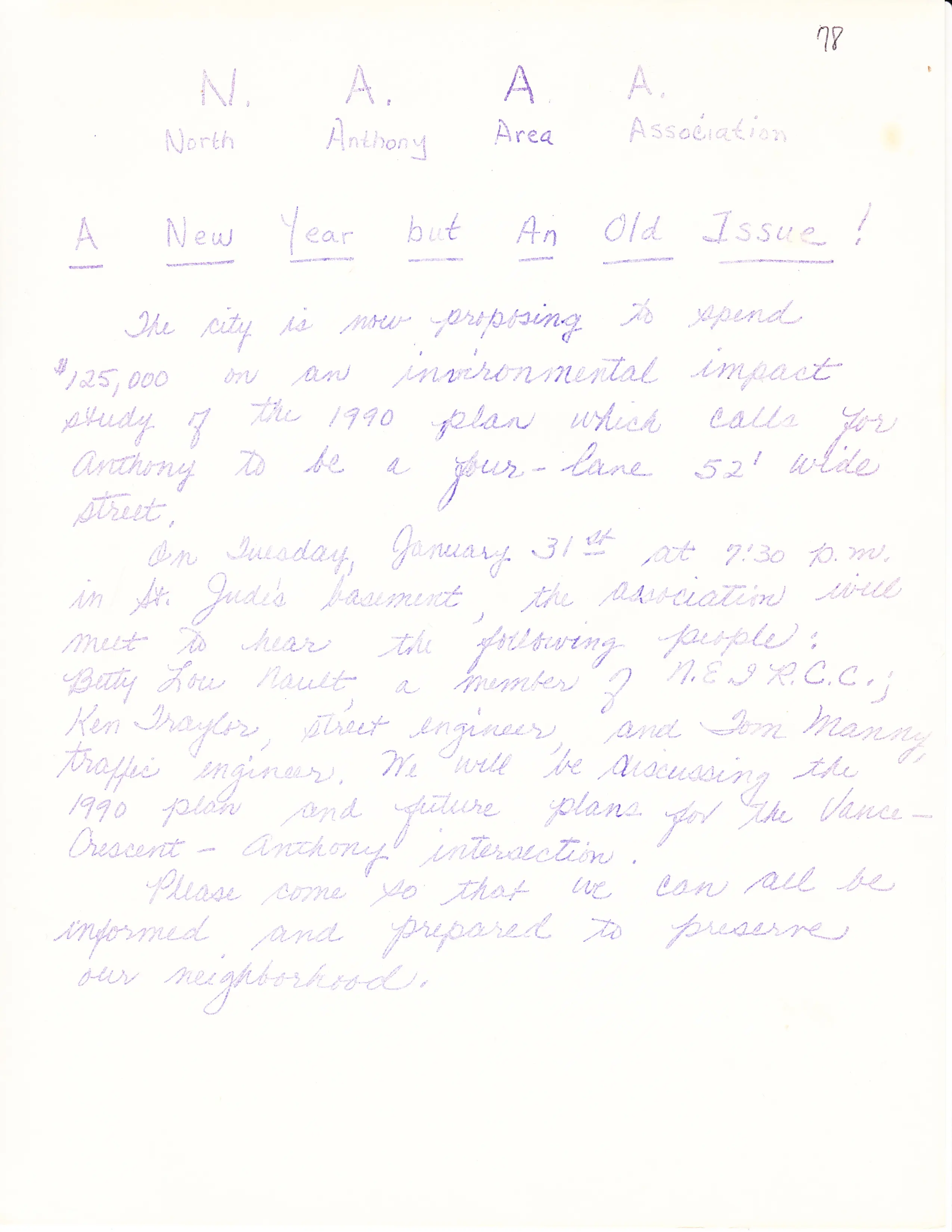
The surviving January 31, 1978 notice shows that the issue was still alive well into the late 1970s. That flyer warns that the city was proposing to spend $125,000 on an environmental-impact study tied to a 1990 plan that would have made Anthony a four-lane, 52-foot-wide street, and it urged residents to attend another meeting at St. Jude’s so they could be informed and “prepared to preserve our neighborhood.” A July 1979 notice continues the same theme, calling concerned residents together to hear facts about proposed city widening and lighting projects and to consider alternate proposals.
Even in these partial records, a pattern is clear: the association’s earliest years were shaped by sustained neighborhood efforts to defend the boulevard’s residential character while also demanding better maintenance, clearer communication, and more responsiveness from city government.
1980s
The scanned issues of The Neighborhood Voice show that by late 1985 the association was actively reorganizing itself for a new round of neighborhood work. The November and December 1985 issues describe a revived North Anthony Area Association, renewed general meetings at Memorial Baptist Church on North Anthony (now St. Joe Community Church, a push for block captains, and a neighborhood forum meant to gather practical concerns from residents. Those early newsletters focus on public safety, nuisance issues, traffic at key intersections, and the basic problem of keeping people connected across the whole association area.
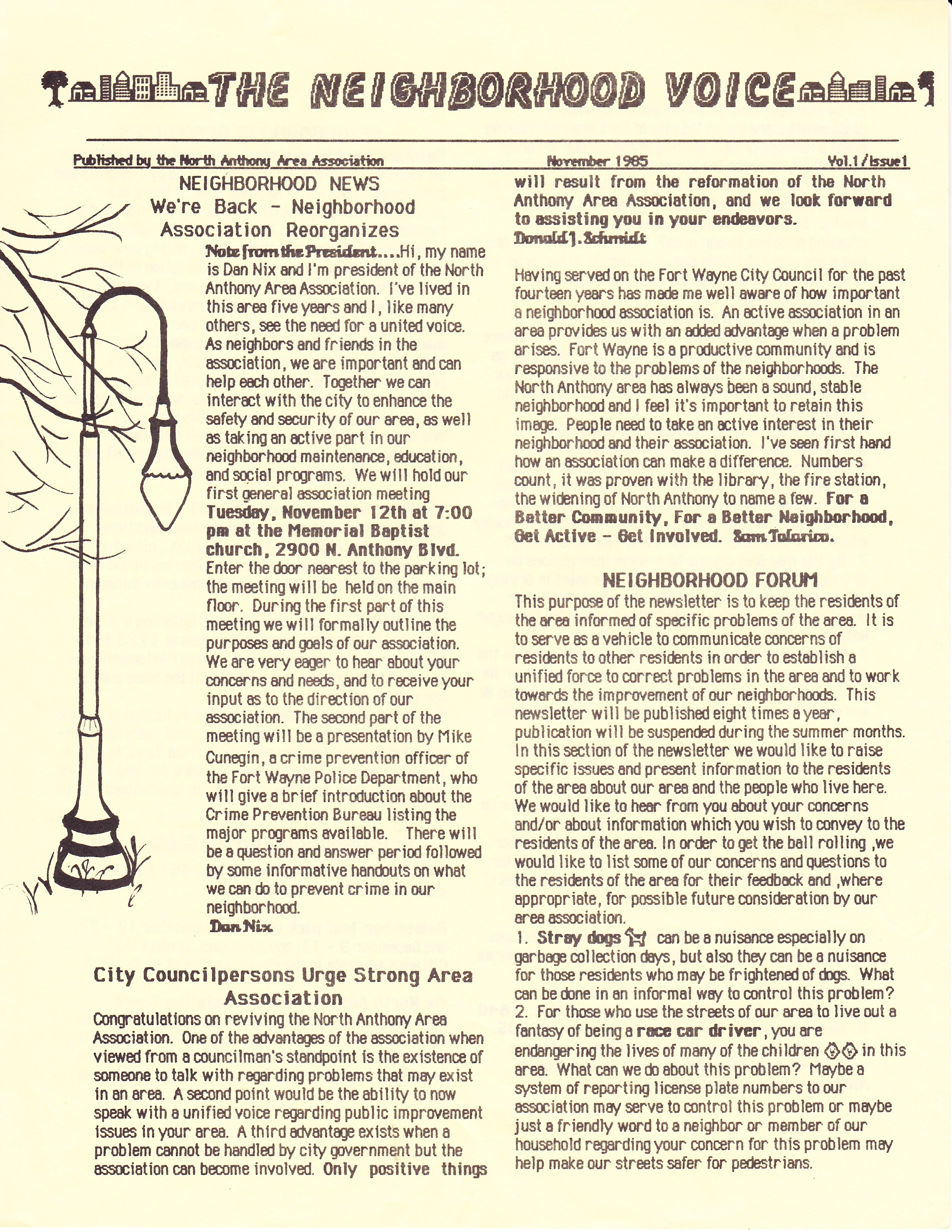
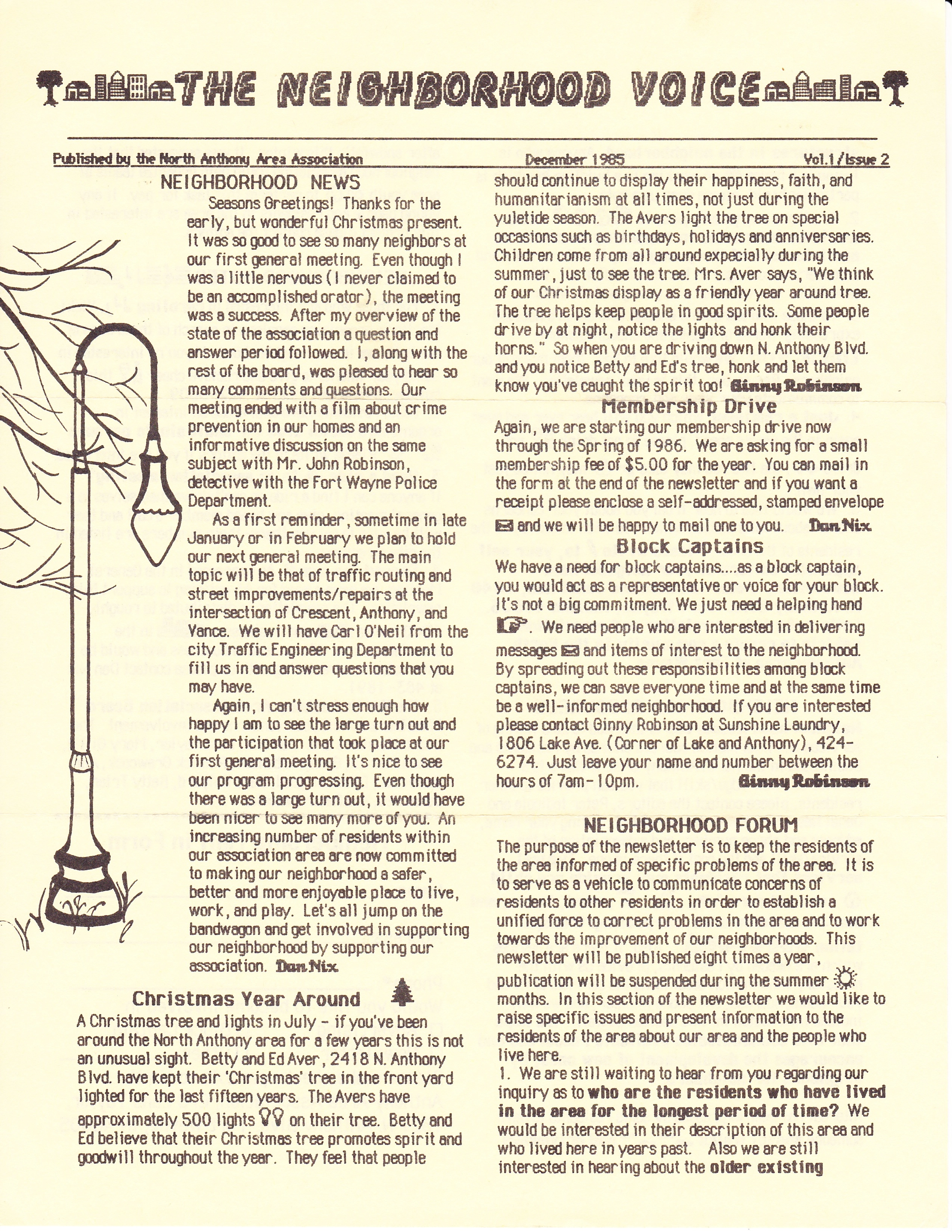
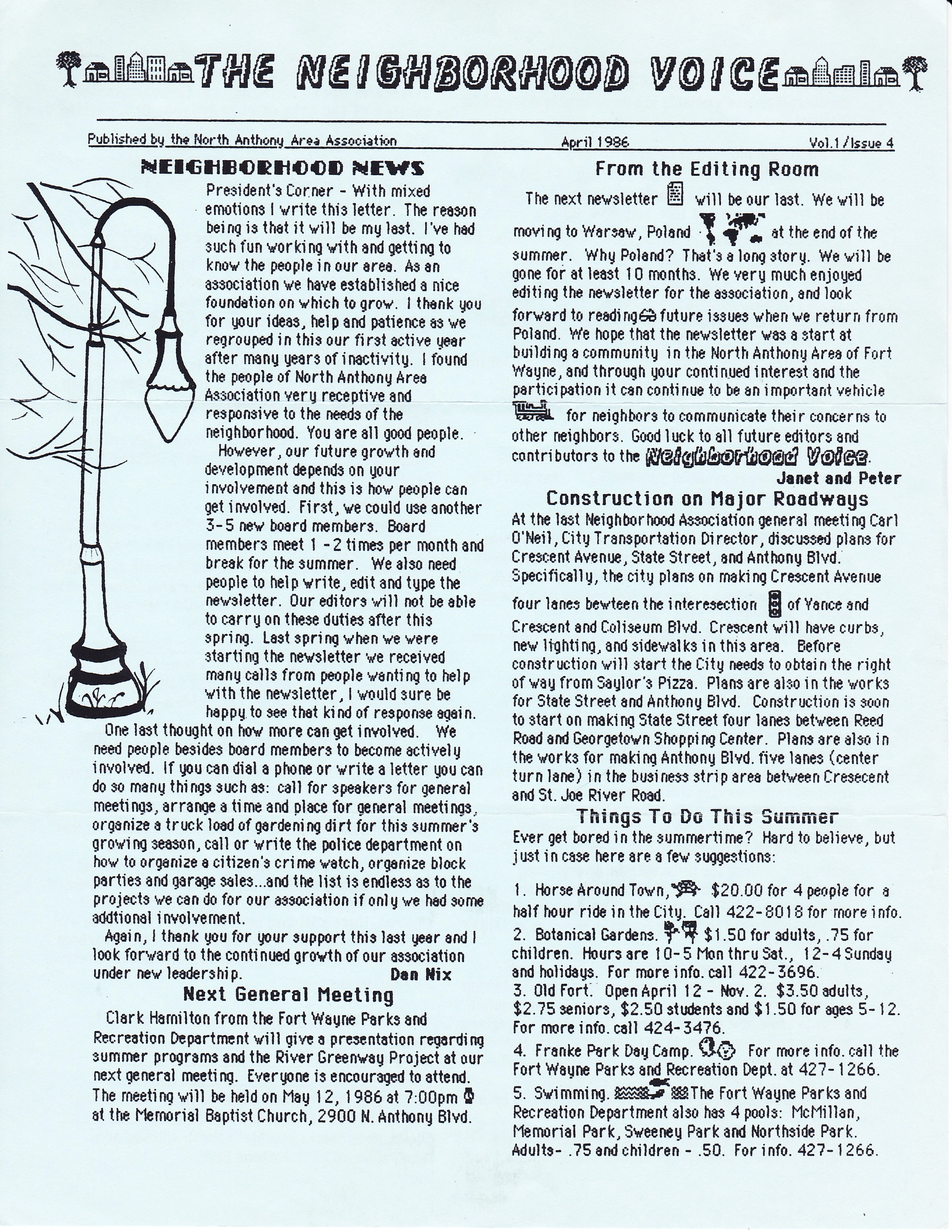
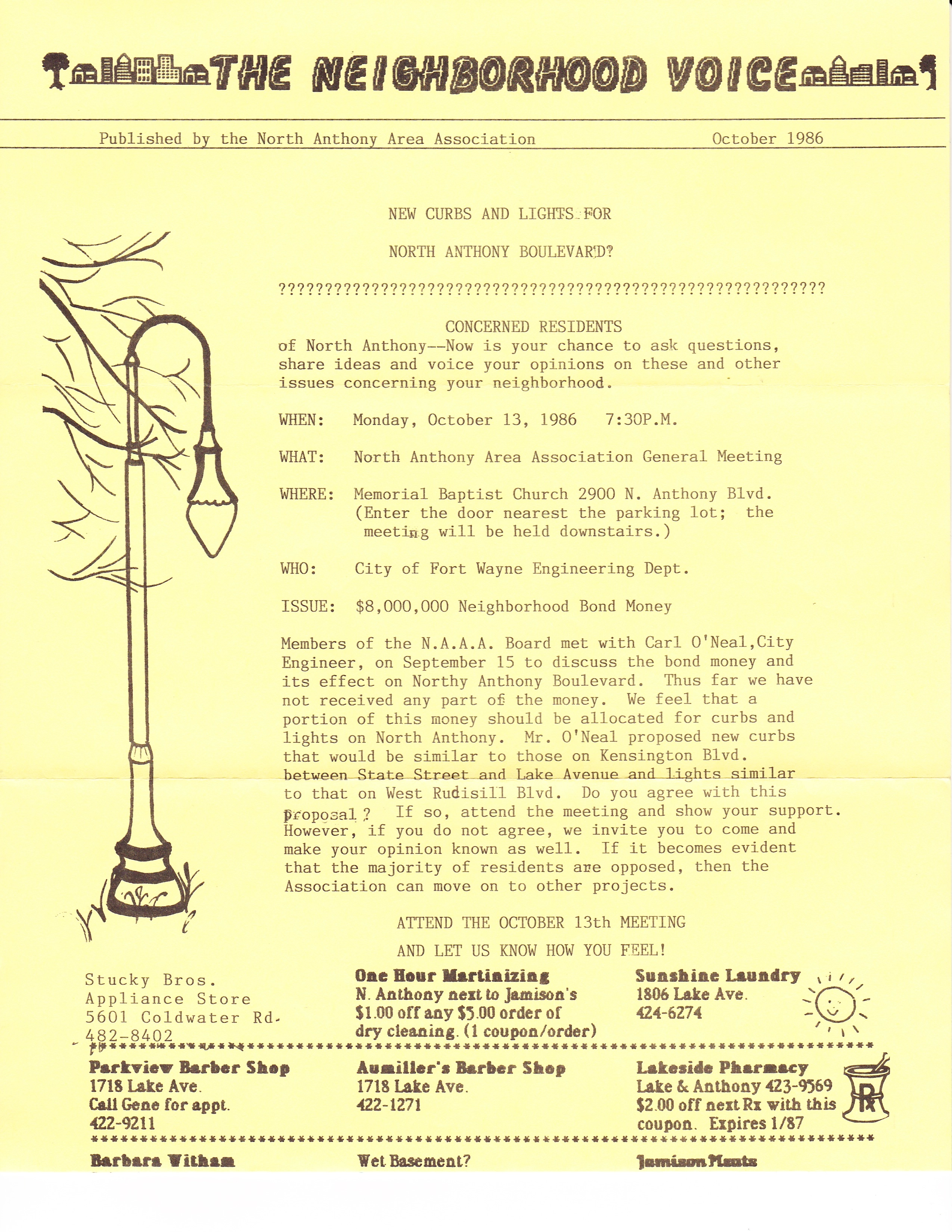
The newsletters also show an organization trying to build durable structure, not just react to crises. A February 1986 issue reports incorporation papers having been filed, block captains being established for all blocks in the association area, and a membership drive tied to spring organizing. Across the 1986 issues, the association used the newsletter to advertise meetings, recruit volunteers, circulate neighborhood information, and connect residents to parks, library programs, and city services. The publication’s recurring lamp-post artwork and the title The Neighborhood Voice suggest that by the mid-1980s the association had developed a more recognizable and regular communications identity than is visible in the surviving 1970s flyers. That masthead featured a drawing of the historic gooseneck street lights that once lined North Anthony; the drawing disappeared from later issues after the 1987 street-light replacement, when those gooseneck fixtures were replaced by straight-post lights. Some of the removed lights were salvaged by Jim Delaney, formerly of Fort Wayne City Utilities, and moved to Science Central, where they remained for years before later being auctioned to private collectors. Their survival means examples still exist as templates for a possible future historic streetlight restoration project.
By 1986, the older widening and infrastructure fights had returned in a new form. The April 1986 newsletter previews discussion of construction on major roads, while the October 1986 issue asks residents to attend a special meeting with the city engineering department about proposed new curbs and lights on North Anthony, funded through neighborhood bond money. The article makes clear that the board saw the project as consequential enough to require broad neighborhood input before moving ahead.
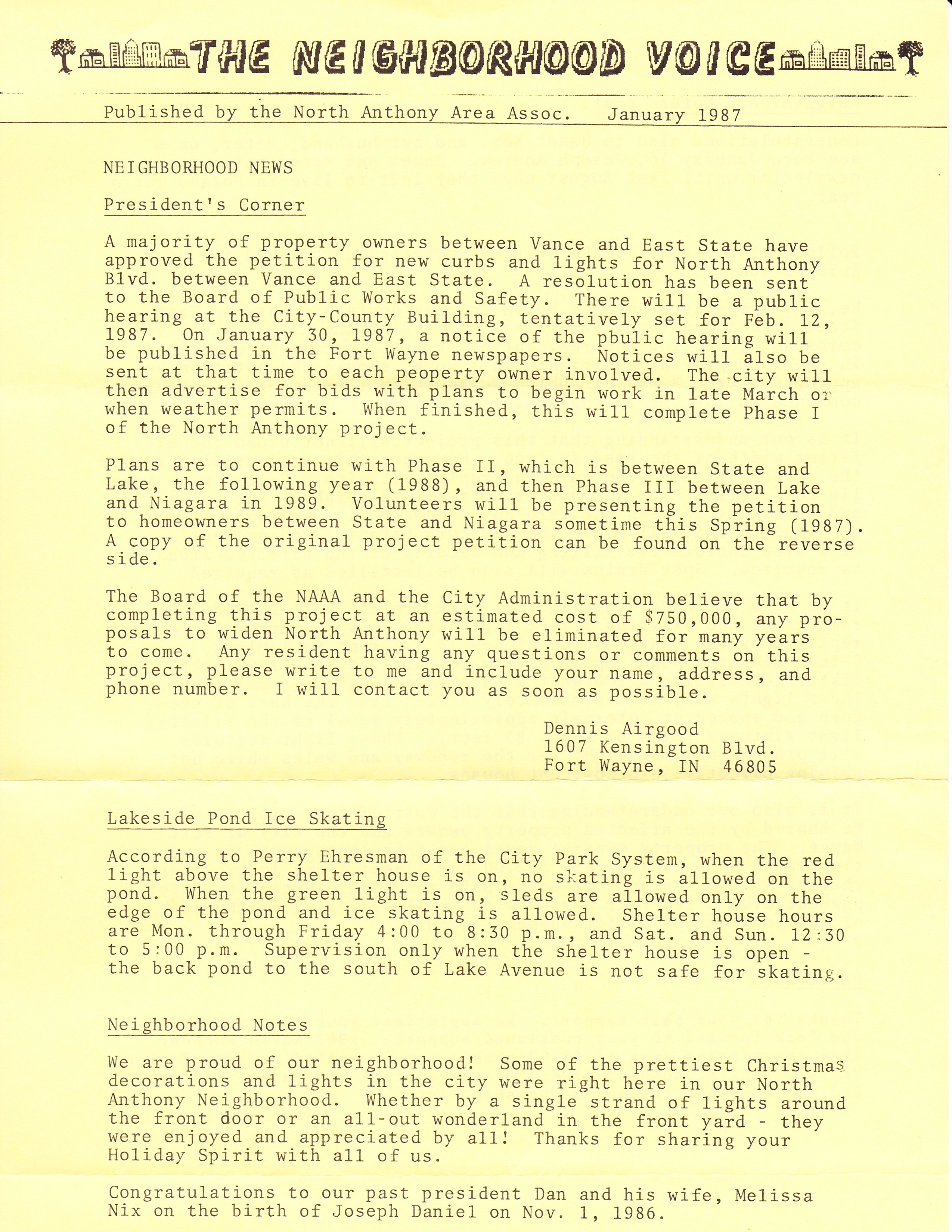
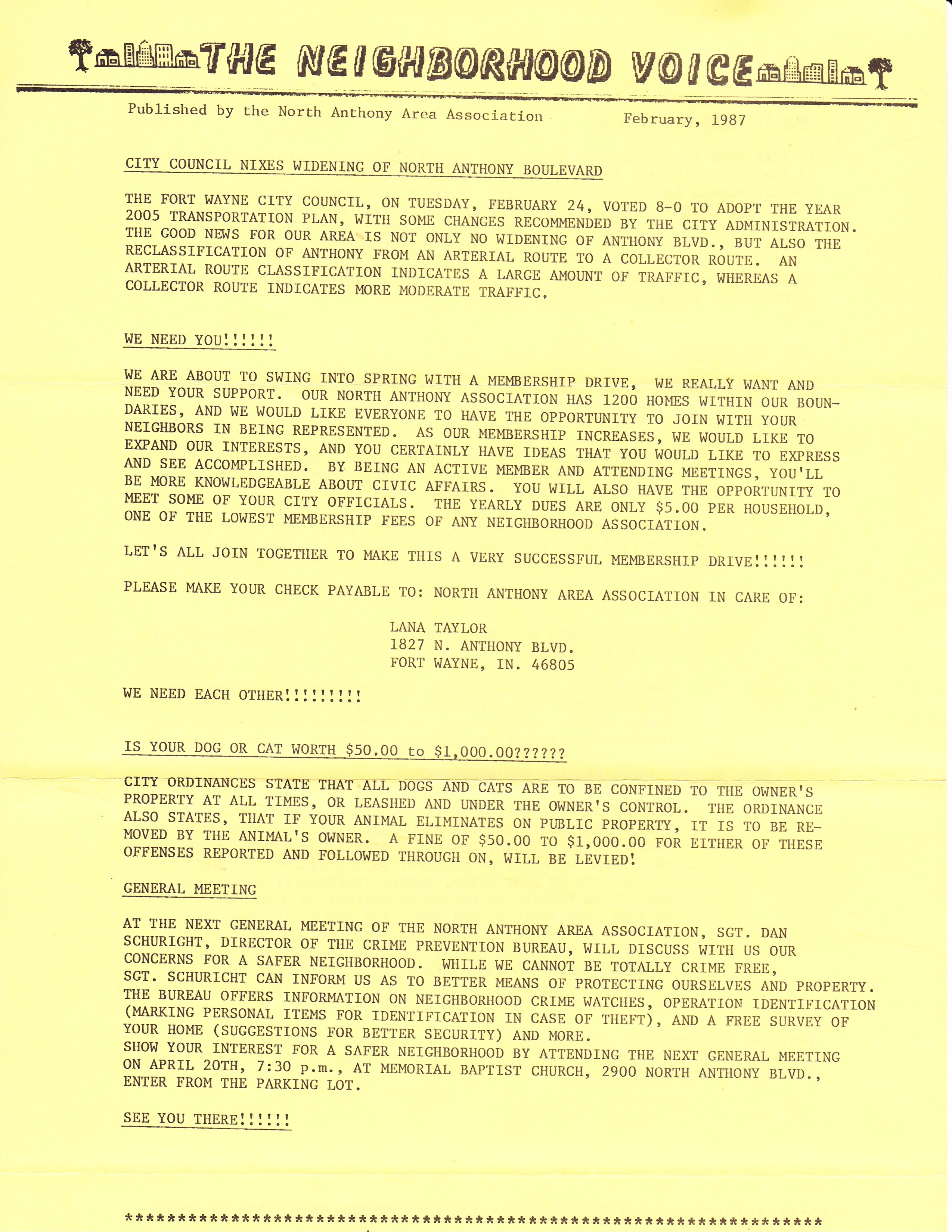
The January and February 1987 newsletters show the association still engaged in that same corridor-level work. President Dennis Airgood reported that petitions from property owners between Vance and East State had helped move forward a public hearing on curbs and lights for North Anthony, with later phases anticipated farther north. At the same time, the February 1987 issue celebrated a city council vote removing the year’s proposed funding for widening Anthony Boulevard and noted the importance of changing the road’s classification from arterial to collector. In other words, the core concern that had shaped the 1970s association had not disappeared. It had simply carried into a new decade, now paired with more mature neighborhood communications, membership drives, and block-level organizing.
2000s
The surviving PDF newsletters suggest that by 2009 the association had entered a more regular, service-oriented phase while still using The Neighborhood Voice to keep residents informed. The November-December 2009 issue ties together several familiar themes: restoring the decorative pillar lights at North Anthony and Niagara and at Lake and Kensington, planning the annual Home and Garden Tour, maintaining neighborhood Christmas lighting, and preparing for officer elections. The same issue also shows the association still centered on recurring neighborhood institutions rather than one-time campaigns, with board listings, meeting dates, and practical notices sitting alongside the president’s update.
By early 2010, the association was also adapting its communication methods. The January-February 2010 newsletter announces a new Facebook group for the neighborhood, using social media both to circulate information and to help residents report suspicious activity more quickly. Even as communication tools changed, the core work looked familiar: preserving neighborhood features such as the pillar lights, running the Home Tour, collecting dues, and keeping residents connected through regular meetings and seasonal projects.
2010s
The 2010s newsletters show an association that was balancing historic identity, neighborhood beautification, infrastructure advocacy, and a gradual modernization of its communications. The Winter 2011 issue still emphasizes elections and dues, but it also highlights alley resurfacing, street repairs, a neighborhood priorities survey, recycling changes, and the growing importance of the association’s Facebook presence. By that point, the group was clearly functioning as both a civic advocate and a practical neighborhood information hub.
Mid-decade newsletters show a more explicit preservation and branding focus. The Autumn 2014 issue discusses the North Anthony Historic District, noting that the residential historic district had been listed on the National Register and describing the association area as containing one of the city’s few historic districts. Those preservation gains, including both the North Anthony Boulevard Historic District and the Kensington Boulevard Historic District designations, were achieved under the leadership of former president Mike Vorndran. The same issue also announces work on a redesigned website and a shift toward e-newsletters, both to improve outreach and to reduce printing and mailing costs. Other items in that issue, including Rivergreenway trail expansion plans and city-council redistricting, show the association paying attention to both neighborhood identity and larger city planning decisions.
The 2015 and 2016 newsletters continue that pattern. The Spring 2015 issue calls attention to the Historic North Anthony logo and website, promotes a wine and beer fest fundraiser, and encourages residents to file petitions for sidewalk repairs or additional street lights. The Winter 2016 newsletter reflects a further communications shift, noting that it would be the only hard-copy issue for the year, with the rest moving electronic. It also uses the Home and Garden Tour not just as a social event but as a way to showcase the neighborhood, attract visitors, and support beautification work such as trees and decorative pillars.
By the late 2010s, the newsletters show a neighborhood association increasingly focused on targeted place-making projects and deferred infrastructure repair. The Winter 2018 issue reports a leadership transition, thanks longtime secretary and former president Kathie Bishop, and highlights the deteriorated sidewalks near Pemberton and Kensington and a new focus on alley infrastructure requests. The Fall 2019 newsletter builds on that work by celebrating a Neighborhood Improvement Grant award of $5,000 to rebuild the historic pillars at Pemberton and Lake. It also pairs that preservation effort with a neighborhood block party, leaf-pickup reminders, and the recurring Christmas Family drive, showing how the association had come to combine historic stewardship with everyday neighborhood organizing.
2020s
The surviving newsletters from the early 2020s show the association working through disruption while keeping its core neighborhood functions intact. The Summer 2020 issue reflects the immediate effects of COVID-19: meetings had shifted online, the official neighborhood garage sale was disrupted, and city bulk-pickup services were temporarily limited. At the same time, the issue reports a major visible success, the long-awaited rebuilding of the Pemberton pillars, with more landscaping still to come. Even in a disrupted year, the association remained focused on dues, maintenance, and preserving neighborhood landmarks.
By Spring 2022, the newsletters show another transition point. President Sarah Warsco announced that personal matters would require her to step down after the next meeting, while still urging members to keep the association active. The issue centers on practical neighborhood concerns: garbage and missed pickup service, the city’s 50/50 sidewalk cost-share program, weed enforcement, and a warning from the Fort Wayne Police Department about catalytic-converter thefts.
After Warsco’s resignation, then-vice president Joe Giant became interim president and was later elected president when a new board was chosen. Under Joe Giant’s leadership, the association paired routine neighborhood administration with more visible fundraising and improvement work. Joe and his wife, Kristin, organized a Beer and Wine tasting fundraiser that helped replenish association funds after a period in which dues had not been consistently collected. Giant also began a petition drive for a stop sign at Kensington and Cody to improve pedestrian safety and helped secure grants for projects that made the neighborhood’s public spaces more active and recognizable, including an outdoor chess table in the Kensington esplanade, facade grants, and bike racks at Lake and Anthony.
When Joe Giant resigned in May 2024, then-vice president Joseph Brennan became interim president and was elected president at the regularly scheduled meeting later that month. Board member Todd Jordan became vice president. Under Brennan, the association focused on stricter adherence to its bylaws and applicable state law in the conduct of meetings, while also expanding the board and officer group. During the same period, Secretary Sarah Beiswanger helped complete the Kensington and Cody stop-sign petition, worked with local artist Mitchell Egly on a new logo that became the basis for a refreshed branding kit funded by a city grant, planned a neighborhood party at Lakeside Park, and managed an insurance claim after the Kensington Boulevard entrance structures were again damaged in an automobile crash.
Taken together, the 2020s materials and these more recent developments show the association continuing an old pattern in new forms: leadership transitions, practical neighborhood problem-solving, fundraising, beautification, and persistent attention to the small civic details that shape everyday life on North Anthony.
This timeline is still being assembled from surviving newsletters, notices, minutes, and newspaper clippings. Additional decades will be added as more material is digitized and reviewed.